|
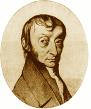
Life of Amedeo
Avogadro
(back to section
Famous Italians)
Count Lorenzo Romano Amedeo Carlo Avogadro di Quaregna e Cerreto
(Turin August 9, 1776 Cerreto? July 9, 1856) - better known
as Amedeo Avogadro -was an Italian scientist born in the Kingdom
of Sardinia ad Piedmont, most noted for his contributions to
the theory of molarity and molecular weight. The number of molecules
in one mole is called Avogadro's number is honor of him, as
is Avogadro's law.
His family's business was the law, and Amedeo followed in his
father's footsteps earning a doctorate of law in 1796. He graduated
in ecclesiastical law at a very young age (20) and began to
practice. However, soon after he dedicated himself to the study
of physics and mathematics, his preferred sciences, and in 1809
he started teaching them (then called positive philosophy) at
a liceo (high school) in Vercelli (where his family had some
properties).
He was apparently
well liked by his students, who appreciated is impish sense
of humor, and quickly settled down into a happy marriage blessed
with six sons. In his free time he did a lot of reading and
had a complete set of the current scientific journals in his
library printed in four different languages.
During this stay in Vercelli he wrote a concise note (memoria)
in which he declared the hypothesis of what we now call Avogadro's
law: equal volumes of gases, at the same temperature and pressure,
contain the same number of molecules; this memoria he sent to
De Lam?herie's Journal de Physique, de Chimie et d'Histoire
naturelle and it was published in the edition of July 14, 1811
with the title Essai d'une mani?e de d?erminer les masses relatives
des molecules ??entaires des corps, et les proportions selon
lesquelles elles entrent dans ces combinaisons (complete English
text here: [1] (http://webserver.lemoyne.edu/faculty/giunta/avogadro.html)
- First page: [2] (http://www.accademiaxl.it/Library/Percorsi/images/Image52.jpg)).
Avogadro's Law implies that the relationship occurring between
the weights of same volumes of different gases (at the same
temperature and pressure) corresponds to the relationship between
respective molecular weights. Hence, relative molecular masses
can be calculated from the masses of gas samples.
Avogadro developed this hypothesis after Joseph Louis Gay-Lussac
had published in 1808 his law on volumes (and combining gases).
The greatest difficulty Avogadro had to resolve was the huge
confusion at that time regarding atoms and molecules ? one of
most important contributions of Avogadro's work was clearly
distinguishing one from the other, admitting that simple particles
too could be composed of molecules, and that these are composed
of atoms. For instance, John Dalton didn't consider this possibility.
Avogadro did not actually use the word "atom" as the words "atom"
and "molecule" were used almost without difference. He considered
that there were three kinds of "molecules," including an "elementary
molecule" (our "atom"). Also, a keener attention was given to
the definition of mass, as distinguished from weight.
In 1814 he published M?oire sur les masses relatives des mol?ules
des corps simples, ou densit? pr?um?s de leur gaz, et sur la
constitution de quelques-uns de leur compos?, pour servir de
suite ?l'Essai sur le m?e sujet, publi?dans le Journal de Physique,
juillet 1811 ([3] (http://www.accademiaxl.it/Library/Percorsi/images/Image54.jpg)),
about gas densities.
In 1820 he became a professor of Turin's university; In 1821
he published another memoria, Nouvelles consid?ations sur la
th?rie des proportions d?ermin?s dans les combinaisons, et sur
la d?ermination des masses des mol?ules des corps and little
after M?oire sur la mani?e de ramener les compos? organiques
aux lois ordinaires des proportions d?ermin?s.
With suspicious enthusiasm, he took part in political revolutionary
movements of 1821 (against the king of Sardinia), so two years
later he was removed from his position (or, as it was officially
declared, the university was very glad to allow this interesting
scientist to take a rest from heavy teaching duties, in order
to be able to give a better attention to his researches). However,
over time this political isolation was gradually reduced, since
revolutionary ideas were receiving increasing attention from
Savoy kings, up to 1848 when Charles Albert granted a modern
Constitution (Statuto Albertino). Well before this, following
the increasing attention to his works, Avogadro had been recalled
at Turin university in 1833, where he taught for another twenty
years.
In 1841 he completed and published his work in Fisica dei corpi
ponderabili, ossia Trattato della costituzione materiale de'
corpi, 4 volumes.
Very little is known about his private life and his political
activity; despite his unpleasant aspect (at least as depicted
in the rare images found), he was known as a discreet tombeur
de femmes although devoted to a sober life and a religious man.
He had six children. Several historical studies would confirm
that he had sponsored and helped some Sardinian plotters who
were organising a revolution in that island, stopped at the
very last moment by the concession of Charles Albert's statute.
Some doubts however remain, considering the very little amount
of evidence.
Avogadro held public posts in statistics, meteorology, and weights
and measures (he introduced decimal metric system in Piedmont)
and was a member of the Royal Superior Council on Public Instruction.
The scientific society didn't reserve a great attention at his
theory, so Avogadro's hypothesis wasn't immediately accepted
when announced. Andr?Marie Amp?e too was able three years later
to achieve the same result by another method (in his Sur la
d?ermination des proportions dans lesquelles les corps se combinent
d'apr? le nombre et la disposition respective des mol?ules dont
leurs particules int?rantes sont compos?s), but the same indifferent
regard was given to his theories as well.
Only with studies by Gerhardt, Laurent and Williamson on organic
chemistry, was it possible to demonstrate that Avogadro's law
was indispensable to explain why same quantities of molecules,
brought to a vapour state, have the same volume.
Unfortunately, in the performance of related experiments, some
inorganic substances showed exceptions to the law. The matter
was finally concluded by Stanislao Cannizzaro, as announced
at Karlsruhe Congress (1860, four years after Avogadro's death),
where he explained that these exceptions happened because of
molecular dissociations which occurred at certain temperatures,
and that Avogadro's law could determine not only molar masses,
but as a consequence, atomic masses too.
Clausius, by his kinetic theory on gases, was able to give another
confirmation of Avogadro's law. Not long after, in his researches
regarding dilute solutions (and the consequent discovery of
analogies between the behaviour of solutions and gases), J.
H. van 't Hoff added his final consensus for the triumph of
the Italian scientist, who since then has been considered the
founder of the atomic-molecular theory.
In honor of Avogadro's contributions to the theory of molarity
and molecular weights, the number of molecules in one mole was
renamed Avogadro's number. Which is approximately 6.02214199
?1023.
But in his own
time, Avogadro's principle was seriously neglected. Historians
of science have several theories as to why this should be so,
as Avogadro was a respected scientist during his life. One possibility
was that a more famous scientist, J. J. Berzelius, was strongly
advocating his "dualism" theory which explained compound substances
(molecules?) on the basis that one half of the compound had
to have a positive charge and the other half a negative charge
(to hold the two halves together). It was hard to see how two
atoms of oxygen in one of Avogadro's "molecules" could have
different charges.
But the real reason
is probably more prosaic. In the clannish world of scientific
discovery, it pays to be at the center of the action. Avogadro
was by this time a professor, and chairman, of physical chemistry
at the University of Turin, but in Italy - far away from the
major science centers of England, Germany, France or even Sweden.
He never got to rub shoulders with the "great ones" of his day,
so his ideas did not receive the credit they deserved.
He was a professor
until his retirement at the age of 74. He died on July 9th,
1856.
(back to section
Famous Italians)
|
|