
Ligurian food
Between the sea and the mountains, on a strip of land that seems to have no room for anything, Liguria has built one of the most ingenious cuisines in Italy. Here basil perfumes the greenhouses of Prà, farinata comes out golden from the wood-fired oven, focaccia greases the fingers and pesto is still born in the marble mortar. The terraces facing the Ligurian Sea give delicate oil, artichokes, rare wines and anchovies, while the hinterland guards chestnuts, mushrooms, wild herbs and vegetable pies. It is a cuisine of few ingredients, chosen with respect: a journey of taste that smells of sun, salt and aromatic herbs.
A cuisine born of ingenuity
Liguria is a narrow, steep region, where good land is scarce and the sea is always close. From this condition came a cuisine of great ingenuity: few ingredients, plenty of greens, oil, preserved fish, vegetables grown on the fasce, the terraces held up by dry-stone walls. According to scholars, the scarcity of pasture for cattle pushed the Ligurians towards fish, herbs and, in farmhouses, small farmyard animals such as rabbit.
A decisive role was played by Genoa, the great port of merchants and navigators. From the Mediterranean routes came spices, dried fruit, pine nuts, raisins and citrus, which tradition then interwove with home-grown herbs. That is why Ligurian cuisine is at once poor and refined: a peasant dish like the vegetable pie lives alongside cappon magro, which presents itself as a true stage set of fish, vegetables and green sauce. In 1863 the famous cookbook *La cuciniera genovese* appeared, considered among the first great texts devoted to the cooking of the Genoese area.
Another characteristic is the distinction between the Riviera di Ponente and the Riviera di Levante, divided by the city of Genoa. In the west olive oil, basil, artichokes and flowers dominate; in the east mushrooms, chestnut flour, herb pies and flavours close to the Lunigiana. In the hinterland people eat with ingredients different from those of the coast, but with the same underlying idea: no waste, lots of fragrance.
Dishes to know
- Pesto genovese First courseA raw sauce of Genoese basil, pine nuts, garlic, cheese and oil, once pounded by hand in a marble mortar with a wooden pestle. It is used to dress trofie, trenette and minestrone, and in some recipes it is mixed with potatoes and green beans. Genoese basil has its own specific PDO, while the sauce has no European designation. Pesto is made at the last moment, so as not to heat the leaves and keep them from turning black, and is thinned with a spoonful of cooking water. In the shops of Liguria it is also found packaged, but the fresh version is eaten in trattorias.
- Basilico genovese Local productBasil with rounded, fragrant leaves, grown in greenhouses and in the open mainly in the Genoa area and around Prà. It is the base of pesto. Its aroma is less minty than that of other varieties, with a sweet and delicate scent. The leaves are small and curved, bright green, and are picked by hand in the warm months. It is used fresh, because cooking makes it lose its aroma, and is bought in markets and delicatessens, in small bunches or in pots. Besides pesto, it goes on pizzas, salads and soups, added at the end of cooking.
- Trofie First courseA small rolled pasta, typical of the Genoa area, especially Recco and Sori. It is made with flour and water, worked by hand, sliding small pieces of dough on the wooden board with the palm of the hand, to form a thin spiral. It is usually dressed with pesto, green beans and potatoes, and the dressing is mixed in the same pot where the pasta and vegetables cook. It is eaten all year round and is one of the best-known dishes of Ligurian cuisine. It is found in the restaurants of the coast and in fresh pasta shops, also dried.
- Pansoti First courseFilled pasta with wild herbs (preboggion) and prescinseua, the Ligurian curd similar to a slightly sour ricotta, triangular in shape. It is dressed with walnut sauce, made by pounding shelled walnuts, bread soaked in milk, garlic and a drizzle of oil, and sometimes with a little cheese. According to tradition it is a dish of the Genoa area and the Tigullio, and it used to be made for Sundays and feast days. The herbs are gathered in the meadows and on the terraces, and vary with the seasons. It is found in the trattorias of the coast and in fresh pasta workshops, often in generous portions.
- Focaccia genovese Street foodA tall, soft focaccia, with olive oil and coarse salt, and dimples on the surface where an emulsion of water, salt and oil collects. In Genoa it is eaten at breakfast, often dunked in cappuccino, or as an afternoon snack, warm and fragrant. It is found in the bakeries all over the city, and is bought by the piece, fresh from the oven. There are also versions with onions, olives or cheese. According to tradition it is eaten at any hour of the day and, on some occasions, it also accompanies richer dishes. It is a symbol of Ligurian cuisine, and the Genoese prefer it two fingers high, with a golden crust.
- Focaccia di Recco col formaggio Street foodA focaccia of very thin dough with fresh cheese (crescenza or stracchino) inside, baked in the oven and served hot. It was born in Recco, in the Genoa area, where it is a specialty of the town. The dough of flour, water, oil and salt is rolled out in two nearly transparent layers, between which pieces of cheese are placed, and it is baked at high temperature. It is usually eaten fresh from the oven, cut into wedges, and accompanied by a glass of Ligurian white wine. It can be found in the focaccia shops of Recco and in many trattorias along the coast.
- Farinata Street foodA thin sheet of chickpea flour, water, oil and salt, cooked in a wide copper pan in a wood-fired oven. It is eaten hot, dusted with pepper, cut into pieces and often wrapped in paper. In Liguria it is also called fainâ. According to tradition it is a humble dish, born as a snack and street food, which has been found for centuries in ports and squares. It is made by letting the batter rest for a few hours, and is generally served in the farinotte, the typical eateries, to be enjoyed with a glass of white wine.
- Cappon magro StarterA spectacular layered salad of boiled fish, cooked vegetables and sailor's hardtack, with salsa verde. It is assembled in the shape of a pyramid, with fish such as sea bream and scorpion fish, prawns, oysters and seasonal vegetables, and decorated with hard-boiled eggs and olives. According to tradition it is a dish for feasts and banquets, originally eaten on lean days, without meat. It requires many preparations and is typical of Genoa and the Riviera. Today it can be tasted in only a few trattorias, above all during the Christmas holidays, usually by reservation.
- Cima alla genovese Main courseA veal pocket filled with meat, eggs, peas, cheese and herbs, sewn up and boiled, then pressed and cut into slices. Inside, when cut, you can see a mosaic of colors, with the green peas, the egg and the pink meat. It is served cold, usually on holidays and in summer, often with a drizzle of oil and a few herbs. According to tradition it is a dish born from making use of leftovers, created to use cheap cuts of meat and vegetables, and today it is a classic of Genoese tables and banquets. It is bought in Ligurian delicatessens, well wrapped in paper, and keeps for a few days in the refrigerator.
- Torta pasqualina Main courseA savoury pastry pie with a filling of chard or artichokes, ricotta (prescinseua) and whole eggs, which remain visible in the slice like yellow half-moons. Traditionally at Easter it was made with thirty-three layers, in memory of the years of Christ, while today fewer sheets of pastry are usually used. It is also eaten cold, and is a dish to take on an outing, on Easter Monday morning, or to serve as a starter at spring lunches. It is bought at Ligurian delicatessens and bakeries, especially around the holidays. The recipe varies from family to family, with additions of marjoram and a little parmigiano.
- Testaroli First courseA dish of flour, water and salt cooked in a testo (a terracotta or cast iron plate), then cut into diamonds and briefly boiled. It is dressed with pesto or with oil and cheese, and in some recipes with mushrooms or a simple sauce. Typical of the Lunigiana, between La Spezia and Massa-Carrara, it is also very well known in the Sarzana area. According to tradition it is a very ancient preparation, made on holidays over a wood fire. The pasta has a soft, elastic texture, and can be kept for a few days. It can be found in the trattorias of the area and in shops selling local products.
- Muscoli ripieni alla spezzina (stuffed mussels) StarterLarge mussels opened and stuffed with meat, eggs, breadcrumb and cheese, then cooked in tomato sauce. They are a dish of the Gulf of La Spezia, where mussels are farmed in large mussel-farming installations. They are opened halfway, filled with a mixture scented with parsley and garlic and tied with a thread before cooking. They are usually eaten hot as a starter, with bread to mop up the sauce. According to tradition they are a festive dish and a classic of La Spezia tables, and are found in the trattorias of the gulf in all seasons, with more demand in summer.
- Pandolce genovese DessertA leavened cake with raisins, candied fruit, pine nuts and fennel seeds, in the tall and the low type. It is made above all at Christmas, and once every Genoese family made a large one to share with guests. According to tradition it is cut with a sprig of bay on top, and it is said that a slice is saved for the first poor person who knocks at the door. It is eaten at breakfast, at the end of a meal or in the afternoon, often with a sweet wine. It is found in the pastry shops of Genoa and Liguria, especially around Christmas.
- Olio extravergine Riviera Ligure Local productAn extra virgin olive oil, typical of the Ligurian coast, in particular from the taggiasca cultivar, with olive trees grown on sloping terraces near the sea. It has a sweet, delicate and fruity taste, with notes of almond and a light finish. There are three mentions: Riviera dei Fiori, Riviera di Levante and Riviera del Ponente Savonese. The harvest is done in autumn and winter, usually by hand, and the olives are pressed early to keep the aroma. It is used raw on fish, vegetables and focaccia, and in pesto. It is bought at the oil mills, markets and shops of Liguria.
- Rossese di Dolceacqua WineA red wine from the rossese grape, grown in the hinterland of Ventimiglia and Bordighera, in vineyards held up by terraces. It has a pale colour, scents of flowers and undergrowth, good freshness and a delicate tannin. It usually pairs with rabbit, light meats and dishes of the hinterland, and is drunk chilled, at cellar temperature. It is a wine of ancient local tradition. Production is small and is sold largely in the area, in the villages of the Val Nervia and nearby ones, including Dolceacqua, dominated by its castle.
Starters, focaccias and baked goods
Ligurian bread has a name worth a whole region: focaccia. The Genoese kind is tall, soft, bathed in a brine of water, oil and salt, with the dimples left by the baker's fingers. It is usually eaten at breakfast, dipped in milky coffee, or as an afternoon snack, and this surprises many travellers used to thinking of it only as a savoury bite. It should be enjoyed hot, fresh from the oven, when the crust is still shiny with oil.
Focaccia di Recco with cheese is something else entirely: two very thin sheets of unleavened dough, between which a fresh, soft cheese is placed, baked in a very hot oven. It has PGI recognition and is linked, according to tradition, to the area of Recco and the Golfo Paradiso. Not to be confused with farinata, made with chickpea flour, water, oil and salt, cooked in copper pans in the wood-fired oven: crisp at the edges, soft in the centre, with a dusting of black pepper.
Among the best-loved starters is cappon magro, a festive dish made of sailors' hardtack, fish, vegetables and green sauce, built in layers like a small monument. On the coast there are also the stuffed mussels of La Spezia, mussels opened and filled with a mixture of bread, eggs and cheese, and the salted anchovies of the Ligurian Sea, which have PGI recognition and are also served with oil, garlic and parsley. To accompany it all, a glass of Ligurian white wine.
First courses: pesto, trofie and filled pasta
Genoese pesto is the symbol of the region. The traditional version calls for basil, pine nuts, garlic, aged cheese, oil and coarse salt, pounded in the marble mortar with the wooden pestle. Genoese basil has PDO recognition and is grown above all in the greenhouses of the Genoese coastal strip, with small, tender, barely minty leaves. Pesto is not cooked: it is loosened with a little pasta water over the still-hot pasta.
The pasta most tied to pesto is trofie, small twisted fusilli rolled by hand, which according to tradition originate in the area of Recco and Camogli. They are usually eaten with potatoes and green beans, boiled together with the pasta: a pairing that surprises anyone seeing it for the first time and wins over anyone who tastes it. Alongside are pansoti, large triangular ravioli filled with wild herbs (the *preboggion*, the mix of herbs gathered in the meadows) and ricotta, dressed with walnut sauce.
In the far east you find testaroli, a very ancient pasta of the Lunigiana made by cooking a liquid batter of flour and water on a terracotta or cast-iron testo; they are cut into diamonds, briefly boiled and dressed with pesto or with oil and cheese. The picture is completed by vegetable minestrone with a spoonful of pesto, fish soups and the meat fillings typical of the hinterland, prepared for festivals.
Main courses: fish, meat and savoury pies
On the sea side, the Ligurian tradition is made of anchovies, squid, octopus, red mullet, cuttlefish, prawns and, in times past, of humble fish cooked simply: fried, stewed with tomato and olives, stuffed. Stoccafisso accomodato, typical of the Imperia area, is made with potatoes, Taggiasca olives, pine nuts, capers and tomato, and shows how a fish that came from far away, preserved dried, became a local classic.
In the Genoa area cima alla genovese is one of the great festive dishes: a stitched pocket of veal filled with eggs, peas, cheese, pine nuts and marjoram, then cooked in broth, pressed and served in cold slices. It is a dish of patience and abundance, made to be shared among many guests.
A place of honour goes to the savoury pies. Torta pasqualina, traditional at Easter, encloses herbs or artichokes, ricotta and whole eggs in a thin, repeated pastry; according to a widespread tradition, the sheets are as many as the years of Christ, but this is a custom handed down rather than documented. The herb pie of La Spezia, simpler, uses chard, rice or bread and cheese. These are dishes to take on an outing, to eat hot or cold, and they say much about the Ligurian idea of practical cooking.
PDF guide
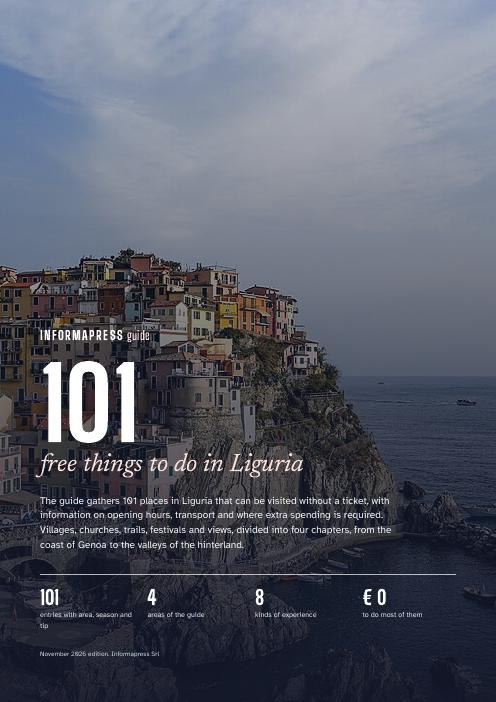
101 free things to do in Liguria
The guide gathers 101 places in Liguria that can be visited without a ticket, with information on opening hours, transport and where extra spending is required. Villages, churches, trails, festivals and views, divided into four chapters, from the coast of Genoa to the valleys of the hinterland.
See the guide, €4.9050 pages, PDF in three languages
↓ The page continues below
Desserts: pandolce, canestrelli and biscuits
The dessert that most represents Genoa is pandolce, a low sweet bread with pine nuts, raisins, candied fruit and fennel seeds, made above all for Christmas. A legend attributes it to a doge who wanted a new sweet with the fruits brought by the ships; it is a charming story, but there is no firm proof. There is also a lower, finer version, almost a panettone without the height, which the Genoese eat with sweet wine.
The canestrelli of Torriglia are flower-shaped biscuits, crumbly and delicate, with a hole in the centre and a dusting of icing sugar. They tell of another Liguria, that of the hinterland villages, where butter and flour are everyday ingredients and biscuits accompany visits and festivals. Alongside are other traditional sweets: amaretti, canestrelli in various shapes, Carnival and St Joseph's Day fritters, and in the valleys spongata, a Christmas sweet of dried fruit and honey.
To close the meal there is sciacchetrà, the passito wine of the Cinque Terre, amber-coloured and scented with honey and apricot, made from dried grapes. It pairs well with dry sweets and aged cheeses, and is served in small sips, as is done with meditation wines.
Cheeses, cured meats and garden produce
Liguria has no great pastures, and so the cheeses are almost all small and fresh: prescinseua, a tangy curd used in pies and fillings, the goat and sheep cheeses of the hinterland, the giuncata of Savona, the fresh cheese used for focaccia di Recco. Among cured meats the products of the valleys are remembered, such as mortadellas and mountain salamis, but the real protagonist of the table is the vegetable garden.
On the plain of Albenga grows the spiny artichoke, with a tender, slightly bitter flavour, while in the hinterland of Imperia Vessalico garlic is braided into fragrant plaits. Fresh broad beans, beans, trombetta courgettes, greenhouse vegetables, Taggiasca olives, pine nuts and aromatic herbs such as marjoram and oregano make up a pantry of Mediterranean flavours. In the neighbourhood markets you also find the wild herbs for preboggion, winter pesto and mountain soups.
The advice for travellers is to look at what is on the stalls: the season changes the landscape of the plate a great deal, and an attentive traveller recognises at once where people eat what the land offers at that moment.
Oil and wine: the landscape in the glass
The extra virgin oil of the Riviera Ligure has PDO recognition and is sweet, delicate, with notes of almond and herbs. It comes from olives grown on steep terraces, often picked by hand; the fruit most tied to the territory is the Taggiasca, which gives a light oil suited to fish, vegetables and pesto. It is the oil used to dress focaccia and to make the brine, and it gives Ligurian flavour an unmistakable sweetness.
The wines are few and rare, because the vineyards are small and laborious to work. Rossese di Dolceacqua has DOC recognition: a fresh, fragrant red, to drink with meats and savoury dishes. Colli di Luni Vermentino, also DOC, is a savoury, light white suited to fish. Pigato, a white of the west, is more structured and scented with herbs and yellow fruit. The white of the Cinque Terre, born on terraces overlooking the sea, completes the picture; a sweet version exists, namely sciacchetrà.
Those who visit Liguria at the right time can witness the olive harvest and pressing at the oil mills, a rite that marks autumn and the beginning of winter. Tasting new oil on a slice of warm bread is, for many travellers, the simplest and most surprising discovery.
Province by province
Genoa
The province of Genoa is the homeland of pesto, PDO basil, focaccia and farinata. In the city people eat focaccia at breakfast, buy farinata cut into wedges and find trofie, pansoti with walnut sauce and cima alla genovese. Towards the east, in Recco, thin focaccia and cheese are a family tradition; in the hinterland, in Torriglia, canestrelli are made. At Christmas, on the table, pandolce is never missing and, depending on the season, cappon magro and torta pasqualina.
- Pesto genovese First courseA raw sauce of Genoese basil, pine nuts, garlic, cheese and oil, once pounded by hand in a marble mortar with a wooden pestle. It is used to dress trofie, trenette and minestrone, and in some recipes it is mixed with potatoes and green beans. Genoese basil has its own specific PDO, while the sauce has no European designation. Pesto is made at the last moment, so as not to heat the leaves and keep them from turning black, and is thinned with a spoonful of cooking water. In the shops of Liguria it is also found packaged, but the fresh version is eaten in trattorias.
- Trofie First courseA small rolled pasta, typical of the Genoa area, especially Recco and Sori. It is made with flour and water, worked by hand, sliding small pieces of dough on the wooden board with the palm of the hand, to form a thin spiral. It is usually dressed with pesto, green beans and potatoes, and the dressing is mixed in the same pot where the pasta and vegetables cook. It is eaten all year round and is one of the best-known dishes of Ligurian cuisine. It is found in the restaurants of the coast and in fresh pasta shops, also dried.
- Pansoti First courseFilled pasta with wild herbs (preboggion) and prescinseua, the Ligurian curd similar to a slightly sour ricotta, triangular in shape. It is dressed with walnut sauce, made by pounding shelled walnuts, bread soaked in milk, garlic and a drizzle of oil, and sometimes with a little cheese. According to tradition it is a dish of the Genoa area and the Tigullio, and it used to be made for Sundays and feast days. The herbs are gathered in the meadows and on the terraces, and vary with the seasons. It is found in the trattorias of the coast and in fresh pasta workshops, often in generous portions.
- Focaccia genovese Street foodA tall, soft focaccia, with olive oil and coarse salt, and dimples on the surface where an emulsion of water, salt and oil collects. In Genoa it is eaten at breakfast, often dunked in cappuccino, or as an afternoon snack, warm and fragrant. It is found in the bakeries all over the city, and is bought by the piece, fresh from the oven. There are also versions with onions, olives or cheese. According to tradition it is eaten at any hour of the day and, on some occasions, it also accompanies richer dishes. It is a symbol of Ligurian cuisine, and the Genoese prefer it two fingers high, with a golden crust.
- Focaccia di Recco col formaggio Street foodA focaccia of very thin dough with fresh cheese (crescenza or stracchino) inside, baked in the oven and served hot. It was born in Recco, in the Genoa area, where it is a specialty of the town. The dough of flour, water, oil and salt is rolled out in two nearly transparent layers, between which pieces of cheese are placed, and it is baked at high temperature. It is usually eaten fresh from the oven, cut into wedges, and accompanied by a glass of Ligurian white wine. It can be found in the focaccia shops of Recco and in many trattorias along the coast.
Imperia
In the province of Imperia oil, Taggiasca olives, Rossese and the flavours of the hinterland dominate. In the Dolceacqua area a fresh, fragrant red is made; in Vessalico garlic plaits are braided; in Imperia and surroundings stoccafisso accomodato is a family speciality. Farinata and vegetable pie are common, and fishermen bring anchovies and oily fish to the table. There is no lack of sweets based on oil and of focaccias with onions or olives.
- Rossese di Dolceacqua WineA red wine from the rossese grape, grown in the hinterland of Ventimiglia and Bordighera, in vineyards held up by terraces. It has a pale colour, scents of flowers and undergrowth, good freshness and a delicate tannin. It usually pairs with rabbit, light meats and dishes of the hinterland, and is drunk chilled, at cellar temperature. It is a wine of ancient local tradition. Production is small and is sold largely in the area, in the villages of the Val Nervia and nearby ones, including Dolceacqua, dominated by its castle.
- Stoccafisso accomodato Main courseDried cod soaked and stewed with potatoes, Taggiasca olives, pine nuts, tomato and herbs. It is a dish of the Riviera di Ponente, for which Badalucco, in the hinterland of Imperia, is known, with a festival dedicated to it. It is eaten in winter, and was once a dish for meatless days, when stockfish arrived from the North and kept for a long time. The soaking lasts a few days, changing the water often, and the cooking is slow. It is usually served hot, with bread and a glass of Ligurian white wine. It is found in the trattorias of the hinterland.
- Aglio di Vessalico Local productGarlic grown in the hinterland of Imperia, in the Arroscia Valley, with pale, very fragrant bulbs. It keeps for a long time, braided into plaits that are hung up at home or in cellars. It is used in pesto and Ligurian sauces, and in many recipes of the hinterland, from bagna cauda to stuffings. It has an intense flavour and a lingering aroma. It is harvested in summer and left to dry in the open air, then sold at the markets and village festivals of the valley, where in the warm months there is often a festival dedicated to the product.
- Olio extravergine Riviera Ligure Local productAn extra virgin olive oil, typical of the Ligurian coast, in particular from the taggiasca cultivar, with olive trees grown on sloping terraces near the sea. It has a sweet, delicate and fruity taste, with notes of almond and a light finish. There are three mentions: Riviera dei Fiori, Riviera di Levante and Riviera del Ponente Savonese. The harvest is done in autumn and winter, usually by hand, and the olives are pressed early to keep the aroma. It is used raw on fish, vegetables and focaccia, and in pesto. It is bought at the oil mills, markets and shops of Liguria.
- Pigato WineA white wine from the pigato grape, typical of the Riviera di Ponente, with golden reflections. It has aromas of Mediterranean herbs, such as thyme and marjoram, and a soft, slightly saline flavor. It usually pairs with fish, stuffed vegetables and dishes with pesto, and also goes well with savory pies. It is grown inland from Albenga, Imperia and Savona, on hills exposed to the sun and sheltered by the mountains, where the grapes ripen evenly. It can be found in Ligurian cellars and restaurants, and is best drunk young, at a cool temperature.
La Spezia
La Spezia and its territory unite sea and Lunigiana. In the gulf the stuffed mussels of La Spezia are made and in Monterosso salted anchovies have a long history; in the Cinque Terre grapes are grown for white wines and for sciacchetrà. From the hinterland come herb pie and testaroli, which are also eaten with pesto. The Colli di Luni, DOC, brings the flavour of Vermentino to the table, and oily fish, fried or stewed, fills the tables in summer.
- Muscoli ripieni alla spezzina (stuffed mussels) StarterLarge mussels opened and stuffed with meat, eggs, breadcrumb and cheese, then cooked in tomato sauce. They are a dish of the Gulf of La Spezia, where mussels are farmed in large mussel-farming installations. They are opened halfway, filled with a mixture scented with parsley and garlic and tied with a thread before cooking. They are usually eaten hot as a starter, with bread to mop up the sauce. According to tradition they are a festive dish and a classic of La Spezia tables, and are found in the trattorias of the gulf in all seasons, with more demand in summer.
- Acciughe sotto sale del Mar Ligure Local productAnchovies caught in the Ligurian Sea, salted and kept in jars. Monterosso, in the Cinque Terre, is closely tied to this tradition, with a long history of fishing and salting. They are eaten rinsed of salt, with oil and lemon, or in fillings, and make an excellent base for sauces and dressings. The fish is cleaned by hand, laid in layers in the jar with salt and left to mature for several months. Anchovies are caught mainly in spring and summer. They are bought in the shops and delicatessens of the Cinque Terre, often in glass jars.
- Torta d'erbe (herb pie) Main courseA savory pie of thin pastry, with wild herbs, chard or zucchini, cheese and eggs. It is a tradition of the La Spezia hinterland, where it is made with seasonal vegetables and a little ricotta or fresh cheese. It is eaten warm or cold as a light meal, and is often taken on outings or as a savory snack, cut into squares. The pastry is rolled very thin, with a rolling pin, and baked in a pan greased with oil. In Ligurian delicatessens and bakeries many versions are found, and every family has its own filling, with herbs gathered in the meadows.
- Testaroli First courseA dish of flour, water and salt cooked in a testo (a terracotta or cast iron plate), then cut into diamonds and briefly boiled. It is dressed with pesto or with oil and cheese, and in some recipes with mushrooms or a simple sauce. Typical of the Lunigiana, between La Spezia and Massa-Carrara, it is also very well known in the Sarzana area. According to tradition it is a very ancient preparation, made on holidays over a wood fire. The pasta has a soft, elastic texture, and can be kept for a few days. It can be found in the trattorias of the area and in shops selling local products.
- Sciacchetrà WineA sweet passito wine from bosco, albarola and vermentino grapes left to dry, produced in the Cinque Terre. It has an amber color and aromas of honey and dried fruit. It is usually served with cheeses and sweets, or on its own, as a contemplative wine. The grapes are picked on the terraces above the sea, choosing the best bunches, and are left to dry for weeks on racks, before pressing. Production is very limited and the work on the steeply sloping terraces is done almost entirely by hand. It can be found in the cellars and wine shops of the Cinque Terre, in small bottles.
Savona
In the Savona area the coast and the hills live together in a landscape of greenhouses, orchards and olive groves. The plain of Albenga is famous for the spiny artichoke, for spring vegetables and for whites such as Pigato. In the valleys of Savona people remember giuncata, amaretti and farinata, as well as basil grown in the territories closest to the sea. It is a province where people eat well all year round, from the spring artichoke salad to the mountain soups of winter.
- Carciofo spinoso di Albenga Side dishA violet artichoke with small thorns, grown on the Albenga plain. It is tender and only slightly bitter, and is also eaten raw in salads, dressed with oil and lemon. The harvest runs from autumn to spring, with the best period in the coldest months. In the kitchen it is used in savory pies, in fillings, stewed and fried, and is part of many recipes of the Riviera di Ponente. According to tradition it is brought to Ligurian tables mainly in winter and at Easter. It is bought in the markets and from producers on the plain, often in bunches tied with the leaves still attached to the stem.
- Pigato WineA white wine from the pigato grape, typical of the Riviera di Ponente, with golden reflections. It has aromas of Mediterranean herbs, such as thyme and marjoram, and a soft, slightly saline flavor. It usually pairs with fish, stuffed vegetables and dishes with pesto, and also goes well with savory pies. It is grown inland from Albenga, Imperia and Savona, on hills exposed to the sun and sheltered by the mountains, where the grapes ripen evenly. It can be found in Ligurian cellars and restaurants, and is best drunk young, at a cool temperature.
- Farinata Street foodA thin sheet of chickpea flour, water, oil and salt, cooked in a wide copper pan in a wood-fired oven. It is eaten hot, dusted with pepper, cut into pieces and often wrapped in paper. In Liguria it is also called fainâ. According to tradition it is a humble dish, born as a snack and street food, which has been found for centuries in ports and squares. It is made by letting the batter rest for a few hours, and is generally served in the farinotte, the typical eateries, to be enjoyed with a glass of white wine.
- Cappon magro StarterA spectacular layered salad of boiled fish, cooked vegetables and sailor's hardtack, with salsa verde. It is assembled in the shape of a pyramid, with fish such as sea bream and scorpion fish, prawns, oysters and seasonal vegetables, and decorated with hard-boiled eggs and olives. According to tradition it is a dish for feasts and banquets, originally eaten on lean days, without meat. It requires many preparations and is typical of Genoa and the Riviera. Today it can be tasted in only a few trattorias, above all during the Christmas holidays, usually by reservation.
- Basilico genovese Local productBasil with rounded, fragrant leaves, grown in greenhouses and in the open mainly in the Genoa area and around Prà. It is the base of pesto. Its aroma is less minty than that of other varieties, with a sweet and delicate scent. The leaves are small and curved, bright green, and are picked by hand in the warm months. It is used fresh, because cooking makes it lose its aroma, and is bought in markets and delicatessens, in small bunches or in pots. Besides pesto, it goes on pizzas, salads and soups, added at the end of cooking.
Street food and markets
Liguria is the region of food eaten standing up, and Genoa is where the habit is most deeply rooted. In the lanes of the old town the fried-food shops prepare panissa, fritters and fried fish in paper cones, while the focaccerie open at dawn and serve still-warm slices to those on their way to work. Farinata is eaten where it is baked, standing, often accompanied by a glass of white wine.
In the towns of the coast the morning markets are the right place to understand the season: fresh anchovies, greenhouse vegetables, aromatic herbs, olives and cheeses. In the villages of the hinterland there are instead weekly markets, which sell mushrooms, chestnuts, honey and garden produce. It is worth arriving early, because the best products go quickly.
How people eat today: osterie, festivals and habits
Today the Ligurian table is experienced above all in simple trattorie and village festivals (sagre), where traditional dishes are served in step with the season: fish in summer, mushrooms and chestnuts in autumn, soups and meats in winter. The festivals, often organised by local associations, are an authentic way to taste dishes uncommon in traditional restaurants.
A typical habit is to eat a little of everything and in small portions, sharing the specialities. Wine is drunk without ceremony, often by the carafe and light. Coffee comes at the end, after a small dessert or a piece of fruit. In many villages of the east and the west, Sunday at the table remains a family rite, with pies, fillings and a homemade focaccia.
The calendar of the table
- JanuaryJanuary is the month of vegetable and legume soups, of minestrone and of stoccafisso accomodato. The festive sweets, such as pandolce, remain on the tables, and in the greenhouses basil grows for the spring.
- FebruaryIn February, between Candlemas and Carnival, sweet and savoury fritters are fried. The first artichokes begin to appear on the plain of Albenga, along with winter vegetables used for pies and fillings.
- MarchMarch brings the first field herbs and the St Joseph's Day fritters, a tradition common in many areas, while the spiny artichokes of Albenga reach the peak of the season.
- AprilApril is the month of torta pasqualina, with herbs and eggs, and of the first fresh broad beans. In the greenhouses basil is abundant and fragrant, and restaurants make pesto with new basil.
- MayIn May people eat broad beans with cheese, fresh anchovies and spring vegetables. Trofie with pesto, potatoes and green beans are a perfect dish for the first outings of the season.
- JuneJune is the time of the best basil, and therefore of the most fragrant pesto. On the sea come anchovies and oily fish, and at the festivals local products are celebrated.
- JulyIn July the coast fills with fish festivals and village parties: fried fish, mussels, anchovies, focaccias and farinata served outdoors. It is also the time of cold dishes and seafood salads.
- AugustAugust is the month of patron saint festivals and of dishes to share. People eat grilled fish, cappon magro in its summer version and stuffed vegetables, while in the mountains the first recipes with mushrooms are sought.
- SeptemberSeptember brings the grape harvest, above all on the terraces of the Cinque Terre and the western valleys. Mushrooms appear in the woods and the first pumpkins; the new wines make themselves known at the grape festivals.
- OctoberOctober is the month of chestnuts and mushrooms: in the hinterland chestnut feasts and autumn festivals are held, with chestnut flour, fritters and necci. The first olive harvests also begin.
- NovemberNovember is the time of new oil, open oil mills and hot soups. People cook pumpkin, legumes and cabbage, and eat warm bread with freshly pressed oil: a simple pleasure, suited to the season.
- DecemberDecember smells of pandolce, canestrelli and cappon magro, the dish of great occasions. On festive tables there are cima alla genovese, fillings and dried-fruit sweets, and in Albenga and the hinterland villages Christmas markets and festivities are organised.
Did you know
- The marble mortar with the wooden pestle is considered the ideal tool for pesto: the very name recalls the Italian verb pestare, to pound, because the leaves must be crushed and not cut.
- In Genoa focaccia is often eaten at breakfast, dunked in milky coffee: a habit that surprises many visitors.
- Trofie, according to tradition, get their shape by rolling the dough under the palm of the hand, a gesture that Ligurian women handed down from generation to generation.
- Cappon magro, despite the name (in the past "magro" meant food without meat), is a sumptuous dish, once prepared for festivals and for the days of vigil.
- Farinata is baked in large tinned copper pans and, according to a widespread tradition, its name in the local dialects changes from city to city.
- The cultivated terraces of Liguria are held up by dry-stone walls, and taken together, if laid end to end, they would form an impressive length: a landscape born of the labour of generations.
- Focaccia di Recco with cheese has PGI recognition, and many local tales recall an origin tied to the time of raids from the sea, when villagers took refuge in the mountains with few provisions; it is a tradition with no certain historical proof.
- Genoese basil has a different scent from that of other areas because it grows in a mild climate, close to the sea, and its leaves are small and barely minty.
- According to local sources, sciacchetrà is made from bunches left to dry for a long time, and only a small quantity of wine comes from each quintal of grapes: that is why it is so rare.
- In Liguria there is a pasta, testaroli, that is cooked on a tool called a testo before it is even boiled: a very ancient technique that comes from the Lunigiana.
- Preboggion, the Genoese mix of wild herbs, is not a single herb but a set that changes with season and place, including borage, wild chard and other field plants.
Practical tips
- Order focaccia in the morning, when it is fresh from the oven: hot it is something else, and at breakfast it is a local habit.
- Always ask whether the pesto is made by hand in the mortar: usually the difference can be sensed in the fragrance and creaminess.
- Taste farinata where they bake it in a copper pan in the wood-fired oven, and eat it immediately, while it is hot.
- If you go to Recco, try the thin focaccia with cheese: it is the most famous, but it is different from the tall Genoese focaccia.
- For products to take home choose new oil, good-quality dried basil, salted anchovies and artisan pasta; always check the label and the origin.
- Visit the covered and neighbourhood markets in the morning: they are the best way to understand which vegetables and fish are in season.
- If you like rare wines, look for Rossese, Vermentino and Pigato in local wine shops: they are often little known outside the region.
- In autumn look for the chestnut feasts and the oil festivals: they are ideal occasions to taste fresh products and seasonal dishes.
- Avoid ordering pesto on just any pasta without asking: trofie, trenette and testaroli are the most traditional pairings.
- At the festivals do not look for overly elaborate dishes: the beauty is in tasting simple recipes, often prepared by the village volunteers.
Editorial texts by Italy Travel Escape. Designations checked on the EU eAmbrosia register.
Tours and activities nearby
Offers from GetYourGuide. Some links are affiliate links: if you book we may earn a commission at no extra cost to you.