
Sardinian food
Pane carasau crisp as paper, porceddu scented with myrtle, culurgionis closed like an ear of wheat, golden bottarga, sheep's cheeses and wines that taste of sun and wind: Sardinia is an island that tells millennia of history at the table. Here sea and pastures live side by side, the coast looks to the scents of the Mediterranean and the interior guards pastoral rites that have remained almost unchanged. Every village has its bread, its pasta, its sweet, and often still makes it by hand, at home, on feast days. This page helps you discover Sardinian cuisine province by province and month by month, with the right tips for sitting down at the table like an islander.
A cuisine of shepherds, fishermen and conquests
To understand Sardinian cooking you have to imagine two Sardinias that have always spoken to each other: that of the pastures and mountains, where sheep, pigs and bread that lasts for months reign, and that of the coasts and lagoons, where fish, shellfish, salt and bottarga count. The two traditions never ignored each other: the shepherd came down to trade cheese and wool, the fisherman went up with salted fish, and from these meetings came flavours that today seem natural but have a long history behind them.
Over the centuries the island has received different influences. Usually remembered are the contacts with the peoples of the ancient Mediterranean, then those with Pisa and Genoa, and finally the long Catalan and Aragonese presence, which left evident traces above all in Alghero, where a variant of Catalan is still spoken and where lobster is prepared according to an old recipe. In Carloforte, on the island of San Pietro, the tradition of the Ligurian settlers instead brought a dish such as cascà, a semolina couscous dressed with vegetables and fish, which tells of another interweaving of cultures.
The Mediterranean diet was recognised by UNESCO in 2010 and Sardinia is one of the most studied territories, also for the longevity of many communities of the interior, in particular of the Ogliastra and the Barbagia. According to many scholars, what counts is seasonal vegetables, pulses, wholemeal bread, cheese and meat eaten in moderation. It is a cautious observation, but it coincides with what you see on the tables: simple dishes, local ingredients, portions to share.
A trait that strikes those who arrive is the culture of hospitality. In many villages it still happens that a guest is welcomed with a tray of homemade sweets and a glass of mirto or wine. Eating in Sardinia often means entering a home, even when you are seated in a farm stay: you are served generously and you always end up with one more taste than you had asked for.
Dishes to know
- Pane carasau Local productA very thin, crisp bread, baked twice: the first bake forms a puffed sheet, which is then split in two and returned to the oven. The dough of semolina, water, salt and yeast is rolled out into thin discs, and the sheets are baked quickly in a very hot oven. It keeps for months and is also called 'music paper'. It is the bread of the shepherds, who carried it with them to the pastures, used to accompany cheeses, cured meats and soups. Pane carasau is also used to make pane frattau, a dish with sauce and egg.
- Porceddu Main courseRoast suckling pig on the spit or in a pit, cooked for a long time over embers of aromatic wood such as myrtle, wild olive or strawberry tree, until the skin becomes crisp. In the 'a carraxiu' version the animal is cooked buried, covered with branches and embers. It is the dish of great occasions, from weddings to village feasts and festivals. According to tradition it is served with pane carasau, and sometimes with myrtle leaves, wild greens and a glass of red wine from the island. The meat, tender inside and golden outside, is cut into pieces on the board.
- Culurgionis d'Ogliastra First courseRavioli filled with potatoes, cheese, mint and garlic, closed by hand with a characteristic 'ear' shaped like a stalk of wheat. The dough is made with durum wheat flour and the closing is done with small folds, like a thin braid, a gesture that takes expert hands. They are typical of Ogliastra and are boiled in water and then dressed with tomato sauce and pecorino. In many villages they are made for festivals and celebrations, and sometimes they are also simply served with melted butter.
- Malloreddus First courseSmall ridged semolina dumplings, shell-shaped, often colored with saffron and dressed with sausage, tomato and pecorino. The dough is worked by hand, and each piece is rolled over a rush basket, or over a small ridged tool, to obtain the ridges that hold the sauce. They are also known as gnocchetti sardi. Once they were a holiday dish, but today they can be found all over the island, in homes and restaurants. The most common dressing is sausage sauce with a little grated Sardinian pecorino.
- Fregola First courseSmall balls of durum wheat semolina, dried and then toasted in the oven. The pasta is made by rubbing wet semolina with the hands, in large containers, and sifting it to get grains of similar size. It is served in broth or with arselle, small clams, in the area of Cagliari and Oristano. The toasting makes it rustic and slightly golden, with a flavor reminiscent of bread. It is also found with meat or vegetable sauce, and suits fish dishes well.
- Su filindeu First courseA semolina pasta drawn by hand into very fine threads, which are layered on top of each other on a tray. Whoever makes it works the dough with a quick gesture, pulling and folding the threads over several passes, and then leaves them to dry in the sun. It is made almost only in Nuoro for the pilgrimages to San Francesco di Lula and is served in sheep broth with pecorino. It is generally made by very few families, handed down from mother to daughter. It is one of the rarest pastas in the world.
- Zuppa gallurese First courseA dish of the Gallura made of layers of stale bread, meat broth, fresh cheese and pecorino, baked in the oven until it forms a golden crust. The bread is moistened with the broth, and between one layer and the next stretchy cheese and sometimes aromatic herbs such as mint are spread. It began as a recipe for leftovers and is a dish typical of weddings and special occasions. It is eaten piping hot, with a texture that recalls that of a timballo. Despite the name it is drier than a true soup, and is served in portions.
- Bottarga di muggine Local productSalted and pressed grey mullet roe, obtained in the wetlands of Cabras, in the Gulf of Oristano. The egg sacs are carefully extracted, salted and left to dry for weeks, until a hard, amber-colored piece is obtained. It is sliced thin or grated over pasta, salads and slices of bread with oil. It is prepared after the summer catch and is also known as the "gold of Cabras". It has a savory, intense flavor, and a small amount is enough to flavor a whole plate of spaghetti.
- Aragosta alla catalana Main courseA dish from Alghero, a city with an ancient Catalan influence, in which boiled spiny lobster is served cold with tomato, red onion, oil and vinegar. The vegetables are cut into thin slices and dressed shortly before serving, so as to leave the lobster all its sweetness. It is a summer dish, tied to lobster fishing in the waters of the Riviera del Corallo. According to tradition it is eaten with the family, often on festive days, and it goes well with a well-chilled Vermentino or a local white wine.
- Sebada DessertA large ravioli of semolina dough filled with fresh sour cheese and lemon peel, fried and served hot with strawberry-tree honey or sugar. The cheese, once melted, stays soft and stringy inside the golden, crisp pastry. Traditionally it is made as a final dessert or as a festive main course, especially in central Sardinia. It is eaten as soon as it is fried, because cold it loses its character. The stringy cheese and the honey create a play of sweet and bitter, and it is often accompanied by a glass of fortified wine.
- Pardulas DessertSmall sweets of thin pastry filled with ricotta, saffron and orange peel, baked in the oven. The filling is worked with eggs and sugar, and the pastry is closed so as to leave a small "eye" or a crimped edge. According to tradition they are made at Easter, but today they are found all year round in pastry shops. They are also called casadinas or formaggelle. In some areas, when fresh cheese is used, they have a more tart flavor, while with ricotta they are sweeter and more delicate. They are served at the end of a meal or as an afternoon snack.
- Papassinos DessertShortcrust biscuits with walnuts, almonds, raisins and vincotto, glazed and decorated with coloured sprinkles. The most common shape is a rhombus or rectangle, cut into pieces, with a light white glaze and sugar sprinkles. They are made above all for the Festival of the Dead, on 2 November, and are eaten in the following days with a glass of sweet wine. They are found under different names: papassini, pabassinas and papassinas. They keep for several days, and sometimes the sweets are given to relatives and friends.
- Pecorino sardo Local productA sheep's milk cheese produced all over the island, in two versions: dolce, with a short ageing of 20 to 60 days, and maturo, over two months. The texture is compact and the flavor, depending on the ageing, goes from delicate to piquant. It is used at the table with bread and honey, in salads and pasta, and grated over soups and gnocchetti. The flocks graze in spring on wild meadows, and the milk of that season is highly appreciated by cheesemakers. It is one of the most representative cheeses of Sardinia.
- Cannonau di Sardegna WineA full-bodied red wine produced all over the island, particularly in the Nuoro area. The grape variety has been grown for centuries, with some local variants in the areas of Ogliastra and Barbagia. It pairs well with roast meats and aged cheeses, pork and lamb dishes, and first courses with flavourful sauces. It is served at cellar temperature, in wide glasses. Sardinians consider the variety one of the flagships of the island's winemaking, and the wines of the mountain villages, often made from old vines, contribute to its fame.
- Vermentino di Gallura WineThe vines grow on granite soils, often sandy, near the sea and the mountains, and the harvests take place at the end of summer. Straw-yellow in color and with an intense scent, it is drunk chilled with fish, shellfish and seafood first courses. In the Gallura it also pairs readily with a starter of fresh cheeses and vegetables. It obtained its status in 1996, and is one of the most appreciated white wines of the Mediterranean.
Bread and starters: from carasau to the shepherds' board
Bread is the soul of the Sardinian table, and every area has its own. Pane carasau, born in the mountains of the Nuoro area, is a very thin sheet baked twice in a wood-fired oven: the first time it puffs up like a balloon, then it is opened in two and put back in the oven to become crisp. According to tradition, this process allowed shepherds to carry it with them for weeks, because once dry it keeps for a long time. Moistened with a little water and dressed with oil, salt and an egg, it becomes pane frattau, one of the best-loved dishes on the island.
Pane guttiau is the same carasau passed through the oven with a drizzle of oil and a pinch of salt, ideal as an aperitivo. Beside these you find civraxiu, the large semolina bread of the Campidano, with a soft crumb and a thick crust, the bread of Ozieri called spianata, the pistoccu of the Ogliastra, the coccoi worked with decoration for festivals and many other shapes that change from village to village. In homes in the interior ceremonial breads are still made, sculpted with scissors and knives, intended for weddings and special occasions.
The typical starter is the shepherds' board: pork or wild boar ham, Sardinian sausage, lonza, fresh and aged pecorino, olives, pickles and, where the tradition survives, a taste of goat's cheeses. Often strawberry-tree honey is added, with its bitterish, decisive flavour, which pairs surprisingly well with the stronger cheeses. On the coast the starter changes face: burrida, grated mullet bottarga on bread or spaghetti, sea urchins in season, octopus salad, mussels and clams.
A dish found on many tables is the panada, a large pie of pastry filled with lamb, eel or vegetables, typical of Assemini and many areas of the Sassari region: it is said to have been born as food to take along for working days in the fields. Today it is found in many villages, with different fillings according to local tradition.
First courses: handmade pasta, soups and minestre
Sardinia is a land of handmade pasta, and it is enough to tour a few villages to discover shapes that exist nowhere else. Malloreddus, also called gnocchetti sardi, are small ridged cylinders of semolina, usually dressed with a sauce of fresh sausage and tomato and a grating of pecorino. Their name recalls, according to the most widespread interpretation, little calves, perhaps for the stocky shape, but it is an etymological hypothesis that not everyone accepts.
The culurgionis of the Ogliastra are ravioli filled with potatoes, cheese and mint, closed with an ear-of-wheat seal that requires expert hands: in the villages of the area they are almost a domestic ritual, and making the pasta together is a way of coming together. The lorighittas, typical of Morgongiori, are thin rings of semolina braided by hand, shared on feast days with a meat broth or a chicken ragù.
Su filindeu, whose name means "threads of God", is a pasta so rare that it is considered one of the most difficult to make in Italy: very thin threads of semolina, laid in layers on a large tray and dried in the sun or in the oven, then served in a sheep broth with fresh cheese. It is made almost exclusively in Nuoro, on the occasion of religious pilgrimages, and is a dish you can taste only on a few occasions of the year.
Fregola, in its Cagliari and Oristano versions, is a pasta of little balls of semolina toasted in the oven, with a nutty flavour, often cooked with clams and cockles or with a meat sauce. In the Oristano area you also find su succu, a small-grain pasta similar to fregola, cooked in a meat broth with cheese. The zuppa gallurese, finally, is not a true soup but a timbale of stale bread, meat broth, sour cheese and stringy pecorino, baked until it forms a golden crust: it is a festive dish typical of Gallura weddings.
The country minestre are not missing, such as favata (or fabada), an intense soup of dried broad beans, lard, sausage and wild fennel cooked in winter and at Carnival, and the barley and vegetable soup, which often accompanies the cold days of the interior.
Main courses: roasts, offal and seafood
The king of main courses is porceddu, suckling pig cooked slowly on a spit over embers of aromatic woods such as myrtle, strawberry tree and holm oak. It is served with crisp skin and very tender meat, accompanied by pane carasau, and is the signature dish of big occasions. In many areas of the island it is cooked outdoors, in pits or before large fires, and is inseparable from village festivals, weddings and gatherings.
Agnello di Sardegna, traditionally raised on pasture and protected by IGP recognition, is cooked roasted, boiled with vegetables or stewed with fennel. It is prepared at Easter, when in many families it becomes the main meal. In the interior kid is also cooked, while wild boar, a very common game, ends up stewed with wine, or in stews that taste of myrtle and juniper.
A special place belongs to offal, cooked with the technique of making use of everything typical of the whole farm tradition. Cordula, a braid of lamb or kid intestine cooked on the spit or stewed with peas, is a classic of the interior and of Easter, and tells how in the past nothing of the animal was thrown away.
On the coast the main courses change flavour completely. In Cagliari people eat lobster alla cagliaritana and shellfish, while in Alghero the famous aragosta alla catalana is prepared, served with onion, tomato and oil, a legacy of the city's long Catalan history. In the Oristano area, in the Cabras lagoon, mullet and eels are fished, and with the mullet's roe, salted and pressed, bottarga is made, which is grated over pasta or cut into thin slices with oil and lemon. In the Sulcis tuna has an ancient tradition, tied to the tuna traps of Carloforte and Portoscuso, and is cooked in dozens of ways.
PDF guide
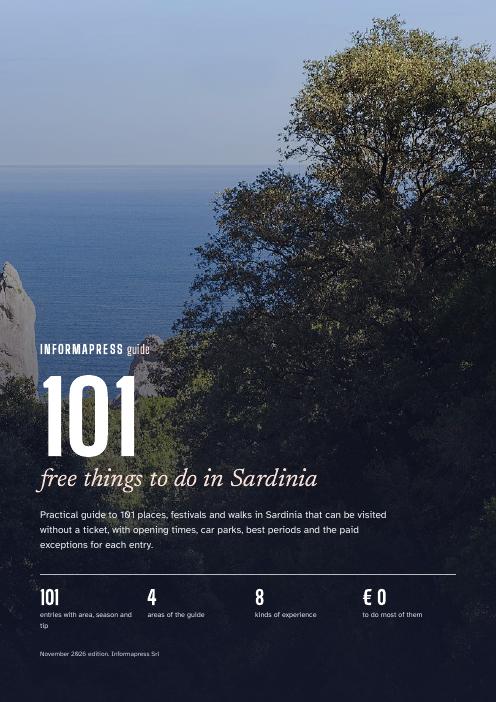
101 free things to do in Sardinia
Practical guide to 101 places, festivals and walks in Sardinia that can be visited without a ticket, with opening times, car parks, best periods and the paid exceptions for each entry.
See the guide, €4.9050 pages, PDF in three languages
↓ The page continues below
Sweets: cheese, almonds, honey and citrus
Sardinian pastry-making is a small universe, in which fresh cheese, ricotta, almonds, honey and citrus combine in sweets that are often made only at certain festivals. Sebadas (or seadas) are perhaps the most famous: large fried ravioli filled with sour fresh cheese, with lemon zest, served hot with honey that melts the cheese inside. They are sweet and savoury at once, and for this reason they surprise those who taste them for the first time.
Pardulas (or casadinas) are Easter sweets based on ricotta or fresh cheese, scented with saffron and orange zest, with a shape that recalls a small dome. Papassinos are shortcrust biscuits covered in icing and enriched with raisins, walnuts and almonds, made above all in autumn and for All Souls' Day. Aranzada, typical of the Nuoro area, is a sweet of candied orange peel and almonds, bound with honey: in the interior it is made for festivals and to offer guests.
Among the pastry curiosities are the pompia, a large citrus fruit with a thick peel grown around Siniscola, from which a round candied sweet is made, and the torrone di Tonara, based on honey, almonds and hazelnuts, often seen in the markets of the interior during festivals. As a rule sweets are accompanied by a small glass of Malvasia or Vernaccia, or by mirto, the berry liqueur with a balsamic scent that is the island's typical toast.
Cheeses and cured meats: the strength of the pasture
In Sardinia sheep far outnumber the inhabitants, and sheep's milk is the basis of a vast repertoire of cheeses. Pecorino sardo, recognised as DOP, exists in two main versions: the dolce, with a soft texture and delicate flavour, and the maturo, more aged and piquant. Pecorino romano, also DOP, despite its name is largely produced in Sardinia itself, where a long industrial and artisanal tradition has made it one of the best-known examples of a grating pecorino. Fiore sardo, DOP, is a hard cheese made from raw milk, smoked and aged: it is one of the oldest products of the island.
A place apart belongs to casu marzu, a fermented cheese with the presence of larvae, traditional in some pastoral areas. It is a controversial product, whose sale is prohibited by hygiene rules: for this reason it is not found in ordinary shops and it is best not to look for it, but it remains one of the symbols of the Sardinian gastronomic imagination. Another speciality is casizolu, a stretched-curd cow's cheese typical of the Montiferru, in the Oristano area, once made by shepherds with the milk of the Sardo-Modicana breed.
Among cured meats the Sardinian sausage dominates, fresh or aged, flavoured with wild fennel and pepper, along with prosciutto, often from semi-wild pigs, guanciale and lonza. In the interior you also find wild boar sausages, made at the end of autumn when the pig is slaughtered. Another excellence is saffron, grown in the lands of San Gavino Monreale and surroundings and protected by DOP: it gives colour and fragrance to soups, sweets and pasta dishes.
Oil and wine: the two great protagonists
The olive tree has grown in Sardinia since very ancient times, and some centuries-old specimens in the Luras area, in Gallura, are among the oldest in Italy. The island's extra virgin olive oil usually has a fruity taste with hints of artichoke and almond and a slight peppery note, and is found in dozens of small olive mills that work mostly from October to December. Among vegetables the carciofo spinoso di Sardegna stands out, protected by DOP, a violet artichoke with pointed bracts, harvested from October to April and eaten raw in salad, fried or stewed with garlic and parsley.
Sardinian wines are a world of their own. Cannonau di Sardegna, DOC, is the most widespread red, full-bodied and spicy, a wine for roast meats and aged cheeses, which in some interior areas, and above all in the Ogliastra, has accompanied the life of farmers for centuries. Carignano del Sulcis, DOC, comes from the south-west of the island from vines often trained as bush vines and ungrafted, and has a soft, warm and fruity character. Vermentino di Gallura, the only Sardinian DOCG wine, is a fresh and savoury white, ideal with fish and with bottarga.
In Oristano they produce Vernaccia di Oristano, DOC, an oxidative white wine, amber in colour and scented with almond, with a long tradition as a companion to sweets and solemn toasts. In Bosa they grow Malvasia di Bosa, DOC, a golden and aromatic wine, sweet or dry, drunk with desserts or with cheese. In Cagliari there is Nuragus, a light and fragrant white that has been part of the everyday table for centuries, drunk throughout the meal with fish. At the end of a meal mirto cannot be missing, made from myrtle berries and leaves, available in a red or white version.
Province by province
Cagliari
Cagliari and its territory are the gateway to a cuisine of sea and countryside together. On the gulf burrida is prepared, a starter of fish marinated in vinegar and walnuts, while fregola with clams is the most representative first course. In the Campidano of Cagliari a soft bread is made, civraxiu, and wheat and vegetables are grown. People eat panadas and almond sweets. In the area Nuragus is produced, a light and fragrant white drunk throughout the meal. A tour of the city markets, in particular in the morning, is a way to see the fish just arrived and to taste products such as bottarga and olives.
- Burrida StarterSmall-spotted catshark or another cartilaginous fish, boiled and marinated with vinegar, walnuts and garlic, typical of Cagliari. The fish, cleaned and skinned, is boiled and left to rest in the sauce, which is made with chopped walnuts, vinegar and parsley. It is served cold, often as a starter, and the flavor is bold, with a contrast between sour and sweet. According to tradition it is prepared for Christmas lunches. In many homes it is left to marinate for a day or two before being brought to the table.
- Fregola First courseSmall balls of durum wheat semolina, dried and then toasted in the oven. The pasta is made by rubbing wet semolina with the hands, in large containers, and sifting it to get grains of similar size. It is served in broth or with arselle, small clams, in the area of Cagliari and Oristano. The toasting makes it rustic and slightly golden, with a flavor reminiscent of bread. It is also found with meat or vegetable sauce, and suits fish dishes well.
- Civraxiu Local productA durum wheat bread typical of the Campidano, with a thick crust and a compact crumb. It is made with semolina, sourdough starter and water, and baked in a wood-fired oven. It keeps for several days and is used for soup and as a base for many dishes. It has a round, golden shape. In many villages it is still sold in artisan bakeries, and the bread is cut into thick slices to go with cured meats, cheeses and vegetables.
- Nuragus di Cagliari WineA light, fresh white wine, produced in the Cagliari area from Nuragus grapes, an ancient Sardinian variety. It has a pale straw color and a delicate scent, with a dry and sometimes lightly sparkling flavor. It is an everyday wine, suited to fish dishes and starters, and goes well with vegetables and light first courses. It is drunk young, well chilled, and in the countryside it has always been a house wine. The name recalls the nuraghi, the ancient stone towers of the island.
- Panada Main courseA savoury pie of semolina and lard pastry, filled with lamb or pork, vegetables and sometimes eels. The dough, worked by hand and left to rest, is rolled out and closed over the filling, with a decorated edge. The best known are those of Oschiri and Assemini. It is made for festivals and village fairs and is a symbol dish of rural cooking. According to tradition shepherds carried it with them on long working days, because it keeps well and can be eaten cold too.
Nuoro
The province of Nuoro includes the Barbagia, the Ogliastra and the east coast, and guards many of the oldest traditions. Here pane carasau was born, here the culurgionis of the Ogliastra and filindeu, the rarest pasta of the island, are made. Among sweets you find aranzada and the torrone di Tonara, while the pompia, a large citrus fruit, grows around Siniscola. The cooking is made of roast meat, cheeses and bread, and is enjoyed above all at village festivals and family lunches, where the wine is often Cannonau, of which the Ogliastra is rightly proud.
- Pane carasau Local productA very thin, crisp bread, baked twice: the first bake forms a puffed sheet, which is then split in two and returned to the oven. The dough of semolina, water, salt and yeast is rolled out into thin discs, and the sheets are baked quickly in a very hot oven. It keeps for months and is also called 'music paper'. It is the bread of the shepherds, who carried it with them to the pastures, used to accompany cheeses, cured meats and soups. Pane carasau is also used to make pane frattau, a dish with sauce and egg.
- Culurgionis d'Ogliastra First courseRavioli filled with potatoes, cheese, mint and garlic, closed by hand with a characteristic 'ear' shaped like a stalk of wheat. The dough is made with durum wheat flour and the closing is done with small folds, like a thin braid, a gesture that takes expert hands. They are typical of Ogliastra and are boiled in water and then dressed with tomato sauce and pecorino. In many villages they are made for festivals and celebrations, and sometimes they are also simply served with melted butter.
- Su filindeu First courseA semolina pasta drawn by hand into very fine threads, which are layered on top of each other on a tray. Whoever makes it works the dough with a quick gesture, pulling and folding the threads over several passes, and then leaves them to dry in the sun. It is made almost only in Nuoro for the pilgrimages to San Francesco di Lula and is served in sheep broth with pecorino. It is generally made by very few families, handed down from mother to daughter. It is one of the rarest pastas in the world.
- Aranzada DessertA sweet made of candied orange peel with honey and almonds, cut into diamonds or rectangles and decorated with granulated sugar. The peels are boiled several times to remove the bitterness, then cooked slowly in honey with the almonds and left to cool on a marble slab. It is typical of the Nuoro area, in the Barbagia, and is eaten at festivals and weddings. It has a sweet and slightly bitter flavor, and it keeps for a long time. It is offered to guests together with a small glass of liqueur.
- Torrone di Tonara DessertA nougat of honey, egg white and hazelnuts or almonds, produced in the town of Tonara, in Barbagia. The honey is cooked slowly in large copper pots, combined with the whipped egg white and the nuts, and the mixture is spread on sheets of wafer. It comes in bars and is traditionally made for festivals and fairs. In the town it is sold at stalls, especially on occasions such as the autumn and early winter festivals. It is one of the best-known Sardinian sweets also abroad.
Oristano
Oristano and its gulf combine lagoons, countryside and mountains. In the Cabras lagoon mullet and eels are fished, from which comes mullet bottarga, famous throughout the island. Among pastas worth remembering are fregola, su succu and the lorighittas of Morgongiori. Casizolu, a stretched-curd cheese, comes from the Montiferru. As for wines, Vernaccia di Oristano and Malvasia di Bosa are two ambassadors of rank, perfect with sweets and cheese. A stop on the Sinis coast allows you to taste freshly caught fish dishes.
- Bottarga di muggine Local productSalted and pressed grey mullet roe, obtained in the wetlands of Cabras, in the Gulf of Oristano. The egg sacs are carefully extracted, salted and left to dry for weeks, until a hard, amber-colored piece is obtained. It is sliced thin or grated over pasta, salads and slices of bread with oil. It is prepared after the summer catch and is also known as the "gold of Cabras". It has a savory, intense flavor, and a small amount is enough to flavor a whole plate of spaghetti.
- Fregola First courseSmall balls of durum wheat semolina, dried and then toasted in the oven. The pasta is made by rubbing wet semolina with the hands, in large containers, and sifting it to get grains of similar size. It is served in broth or with arselle, small clams, in the area of Cagliari and Oristano. The toasting makes it rustic and slightly golden, with a flavor reminiscent of bread. It is also found with meat or vegetable sauce, and suits fish dishes well.
- Lorighittas First courseSemolina pasta braided by hand into small rings, typical of Morgongiori. Each ring is made by twisting two thin strands of dough around the fingers, in a slow gesture that requires a lot of patience. They are cooked in chicken broth or with meat sauce, and are prepared above all for the town's festivals and fairs. The women of Morgongiori have handed down the technique from generation to generation. They are considered a heritage of patience and skill, and one of the most distinctive fresh pastas of the island.
- Su succu First courseA soup of small semolina balls cooked in meat or vegetable broth and served with fresh pecorino. The balls are made by rubbing the semolina with water between the hands, to obtain grains of different sizes, and are cooked in the broth until they swell. It is a simple, comforting dish, typical of the Oristano area. It is usually eaten in winter, when the cold invites a hot dish, and the fresh cheese, sour and stringy, is added to the steaming broth at the moment of serving.
- Casizolu Local productA stretched-curd cheese made from the milk of Sardinian-Modicana cows, produced in the Montiferru. It is pear-shaped and is eaten fresh or aged. The curd is stretched by hand, shaped and left to rest in brine, then the cheeses are hung to age. The milk comes from cows raised at pasture in the meadows of the plateau. It is served in slices with carasau bread or grilled. The name comes from the Sardinian casu, cheese.
Sassari
The province of Sassari embraces Gallura, Logudoro, Anglona and the Riviera del Corallo. In Alghero aragosta alla catalana is prepared, a legacy of a long history of Catalan influence. In Gallura people eat zuppa gallurese, a festive dish of bread, broth and cheese, and Vermentino is produced, the fresh white that is the island's only DOCG. In the Sassari area and the Logudoro panada is never missing, a pie filled with meat or eel, while broad beans, vegetables and cheeses fill the markets. In this area the cooking joins sea and mountains naturally.
- Aragosta alla catalana Main courseA dish from Alghero, a city with an ancient Catalan influence, in which boiled spiny lobster is served cold with tomato, red onion, oil and vinegar. The vegetables are cut into thin slices and dressed shortly before serving, so as to leave the lobster all its sweetness. It is a summer dish, tied to lobster fishing in the waters of the Riviera del Corallo. According to tradition it is eaten with the family, often on festive days, and it goes well with a well-chilled Vermentino or a local white wine.
- Zuppa gallurese First courseA dish of the Gallura made of layers of stale bread, meat broth, fresh cheese and pecorino, baked in the oven until it forms a golden crust. The bread is moistened with the broth, and between one layer and the next stretchy cheese and sometimes aromatic herbs such as mint are spread. It began as a recipe for leftovers and is a dish typical of weddings and special occasions. It is eaten piping hot, with a texture that recalls that of a timballo. Despite the name it is drier than a true soup, and is served in portions.
- Vermentino di Gallura WineThe vines grow on granite soils, often sandy, near the sea and the mountains, and the harvests take place at the end of summer. Straw-yellow in color and with an intense scent, it is drunk chilled with fish, shellfish and seafood first courses. In the Gallura it also pairs readily with a starter of fresh cheeses and vegetables. It obtained its status in 1996, and is one of the most appreciated white wines of the Mediterranean.
- Panada Main courseA savoury pie of semolina and lard pastry, filled with lamb or pork, vegetables and sometimes eels. The dough, worked by hand and left to rest, is rolled out and closed over the filling, with a decorated edge. The best known are those of Oschiri and Assemini. It is made for festivals and village fairs and is a symbol dish of rural cooking. According to tradition shepherds carried it with them on long working days, because it keeps well and can be eaten cold too.
Sud Sardegna
The South Sardinia area, with the Sulcis and the Medio Campidano, has a tradition of tuna, salt and old vines. Carignano del Sulcis, a soft red from vines often trained as bush vines, is the symbol wine of this corner. Civraxiu, the large bread of the Campidano, accompanies many tables, while the saffron of San Gavino Monreale, protected by DOP, gives colour to soups and sweets. The island of San Pietro with Carloforte preserves a Tabarchino Ligurian cuisine, with semolina cascà and tuna dishes, one of the most curious gastronomic interweavings of the Mediterranean.
- Carignano del Sulcis WineA red wine produced in the Sulcis from Carignano grapes, often ungrafted, that is, on their own roots, in the coastal sands of Sant'Antioco. The bush-trained vines resist phylloxera thanks to the sandy soil, and some are very old. It has body and a soft flavor. It pairs with meats, cheeses and game dishes. The younger versions are served slightly cool, while the riserva wines age in the cask. The Sulcis area, between sea and mines, is one of the most distinctive on the island for viticulture.
- Civraxiu Local productA durum wheat bread typical of the Campidano, with a thick crust and a compact crumb. It is made with semolina, sourdough starter and water, and baked in a wood-fired oven. It keeps for several days and is used for soup and as a base for many dishes. It has a round, golden shape. In many villages it is still sold in artisan bakeries, and the bread is cut into thick slices to go with cured meats, cheeses and vegetables.
- Zafferano di Sardegna Local productA spice obtained from the stigmas of Crocus sativus, grown mainly in the area of San Gavino Monreale. The harvest is done by hand in October and November, at dawn, when the flowers are still closed. Each flower has three stigmas, which are picked off one by one and carefully dried. Thousands of flowers are needed to obtain a few grams. It is used in malloreddus, in desserts such as pardulas and in various rice or fish dishes, where it gives an intense golden color and a characteristic aroma.
Street food and markets
Sardinia does not have a great street food tradition in the modern sense, but it has many ready-to-eat bites that are eaten while walking: the panadine and small panadas, the Sardinian pizzetta, oven-baked sweets such as papassinos or hot sebadas on festival days. In Cagliari, in the streets near the sea, you also find fried fish served in paper cones. In the little harbours you can taste sea urchins, in season, and clams cooked in a pan.
City markets are the best way to understand what people eat. In Cagliari and Sassari the covered stalls in the morning show fish, vegetables, sheep's cheeses, cured meats, bottarga and bread of every shape. In the small villages of the interior the weekly market is instead a social occasion: people buy bread, pecorino and almond-paste sweets, and meet the locals. Those who want to take home something authentic can choose pecorino, bottarga, strawberry-tree honey, saffron, mirto and oil, trying to buy from producers and reading the labels carefully.
How people eat today: farm stays, village festivals and habits
Today in Sardinia you eat well in many kinds of places: village osterie, family trattorias, farm stays scattered through the countryside and seafood places along the coast. The farm stays of the interior often offer a set meal, usually very long, with a board of starters, two first courses, mixed roasts, cheeses, sweets and wine, to share at cheerful long tables. It is best to arrive unhurried and with an appetite, because the pace of the lunch is slow and the ritual counts as much as the food.
The sagre, the village food festivals, are an integral part of island life. Every village has its own, dedicated to the patron saint or to a product: from the fish festival to the lamb festival, from the artichoke to the almond. They are precious occasions for tasting local dishes and learning about traditions, often accompanied by folk songs and dances. A habit that surprises is that of opening homes: during some events, such as Autunno in Barbagia, families welcome visitors into their courtyards and offer sweets, cheeses and wine.
A simple rule holds for the whole island: order what is typical of the place, not what you find everywhere. On the coast it is better to prefer the fish of the day, in the interior roast meat and cheeses. Mealtimes are generally the Italian ones: lunch between noon and 2:30 pm, dinner after 8 pm, with some places serving later in summer.
The table through the year
- JanuaryJanuary is the month of pulse soups and of pig processing in the interior. Favata warms the tables, and simple sweets begin to be prepared for Carnival. It is also the season of spiny artichokes, harvested from October to April. On 17 January, the day of Sant'Antonio Abate, big bonfires are lit in many villages, with tastings of sweets and wine.
- FebruaryFebruary is the time of Carnival, with fried sweets such as ricotta fritters and orillettas, and with the fabadda of the Sassari area. In the interior people still eat soups and roasts, while artichokes and wild fennel arrive in the markets. The coastal fish season continues with sea bream and sea bass.
- MarchMarch brings the first wild asparagus and field herbs, which end up in frittatas and minestre. Sweet preparations for Easter begin, when pardulas and almond sweets are kneaded. In the Campidano artichokes are still harvested, while in the countryside it is the time of lambs and kids.
- AprilApril is the month of Easter in most years: lamb, cordula, pardulas and fresh cheese arrive on the tables. In the countryside almond trees and broom flower, and the markets fill with broad beans, peas and artichokes. The first spring fish begins to be tasted.
- MayMay is dominated by the feast of Sant'Efisio, which in Cagliari is celebrated with a long procession starting on the first day of the month. It is the time of fresh broad beans, peas and lamb, but also of fresh pecorino. On the coast the fishermen's outings resume, and at village festivals ricotta sweets are served.
- JuneJune is the month of the first fruits of summer: peaches, apricots, cherries. People eat octopus salads, mussels and shellfish, while in the countryside bread is baked in wood-fired ovens. The great village festivals begin, with outdoor roasts and fresh wines such as Vermentino.
- JulyJuly is the time of grilled fish, shellfish and dinners on the beach. In the coastal areas bottarga, tuna, sea urchins and fregola with clams are enjoyed. In the countryside tomatoes, aubergines and peppers are gathered, while the village festivals fill the squares.
- AugustAugust brings the Candelieri festival in Sassari, on 14 August, and many summer festivals across the island. Seasonal vegetables dominate the tables, along with grilled fish and the porceddu of the big festivals. It is also the month of prickly pears and fresh figs, which go well with cheeses.
- SeptemberSeptember is the month of the grape harvest, when Cannonau, Vermentino and Carignano are picked. In many villages of the interior Autunno in Barbagia begins, the event that opens courtyards and offers sweets, bread and cheeses. Figs are gathered and the first sweets made with must and sapa are prepared.
- OctoberOctober is the time of new oil and of artichokes returning to the markets. Autunno in Barbagia continues, with tables laden with cheeses, sweets and new wine. In the forests chestnuts and mushrooms are gathered, and people begin to make pane carasau for the winter.
- NovemberNovember brings chestnuts, pomegranates and the first pulse soups. On All Souls' days papassinos and other traditional sweets are made. The pig is slaughtered in the countryside, and sausages and hams begin to be cured. Wild boar hunting provides meat for stews and cured meats.
- DecemberDecember brings the sweets of the festive season: torrone, papassinos, amaretti, almond paste and honey sweets. People eat soups, roasts and lamb, while new oil dresses bread and vegetables. In the Christmas period many families still make traditional sweets at home, handed down from mother to daughter.
Did you know
- Pane carasau is baked twice: the first time it puffs up like a balloon, then it is opened into two sheets and put in the oven again. According to tradition, this made it suitable for long periods at pasture.
- Su filindeu, the "threads of God", is made above all in Nuoro and is considered one of the most difficult pastas to make by hand.
- The island of San Pietro, with Carloforte, preserves a cuisine of Ligurian origin brought by settlers, in which cascà and tuna dishes appear.
- In Alghero the cooking bears evident traces of the long Catalan presence, and a variant of Catalan is still spoken today.
- The Mediterranean diet was recognised by UNESCO in 2010, and the Ogliastra is often cited in studies on the longevity of its inhabitants.
- Vermentino di Gallura is the only Sardinian wine with DOCG recognition.
- Pecorino romano, despite its name, is produced largely in Sardinia.
- Mullet bottarga is obtained from the fish's roe, salted and pressed, and is usually grated over pasta or cut into thin slices.
- Porceddu is usually cooked over embers of aromatic woods such as myrtle and strawberry tree, which give it a particular fragrance.
- Strawberry-tree honey has a bitterish flavour, rare among honeys, and according to tradition it pairs in a special way with cheeses.
- Casu marzu is a traditional cheese with larvae whose sale is prohibited: for this reason it is not found in ordinary shops.
- In the Luras area, in Gallura, very old olive trees grow, among the oldest in Italy.
Practical tips
- Order pane frattau and culurgionis in places in the interior: they are dishes that give their best where they are made at home.
- To taste porceddu look for a farm stay that cooks it on a spit over embers and book in advance, because it is usually prepared on request.
- On the coast choose the fish of the day and ask how it is cooked, preferring simple preparations grilled or in acqua pazza.
- Do not look for casu marzu in ordinary restaurants: it is a product banned from sale, and it is best to avoid dubious offers.
- Take home pecorino, bottarga, strawberry-tree honey, saffron, mirto and oil, buying them preferably from producers and reading the labels.
- For Autunno in Barbagia, from September to December, consult the official programme of the year, because the villages involved and the dates change with each edition.
- If you are invited to drink mirto, accept: it is the typical toast at the end of a meal, and it is served very cold.
- The farm stays of the interior offer long meals with several courses: arrive unhurried and with an appetite, and do not fill up already on the starter.
- Among wines look for Cannonau with roasts and aged cheeses, Vermentino with fish and Vernaccia or Malvasia with sweets.
- Spiny artichokes are found from October to April: out of season be wary of offers that are too rich in artichokes.
Editorial texts by Italy Travel Escape. Designations checked on the EU eAmbrosia register.
Tours and activities nearby
Offers from GetYourGuide. Some links are affiliate links: if you book we may earn a commission at no extra cost to you.