
Sicilian food
Sicily is an island that tells three thousand years of history at the table: Greeks, Arabs, Normans, Spaniards and French have left in every dish a fragrance, a spice, a technique. Here the sun ripens citrus, tomatoes, capers and almonds of rare intensity, the sea gives swordfish, sardines and tuna, Etna gives pistachios, wines and prickly pears. You pass from the street food of Palermo, made of panelle, arancine and sfincione, to sweets of ricotta and almond paste, from the fish couscous of Trapani to the pasta alla Norma of Catania. This guide accompanies those who travel and those who live on the island, province by province and month by month, in discovering a generous, colourful and surprising cuisine.
A cuisine of encounters and sun
Sicilian cooking is the result of a long stratification of peoples. According to tradition, the Greeks brought the olive tree, the vine and wheat; the Arabs, from the ninth century, introduced citrus, sugar cane, rice, almonds, jasmine, the technique of sorbet and probably the use of raisins and pine nuts in sweet-and-sour dishes. The Normans and the Swabians consolidated the great wheat crops, while the Spaniards brought from the New World tomato, pepper, chocolate, maize and prickly pear, today inseparable from the landscape and the table.
To these influences is added the work of the monasteries, where nuns developed for centuries sweets of ricotta and almond paste, and that of the monsù, the French-trained cooks of aristocratic households, who left names and techniques still recognisable in the dialect of Palermo's kitchens. Alongside this rich tradition there is a farm one, made of bread, pulses, wild greens, ricotta and little fat, which remains the true basis of everyday eating.
The character of the island is recognised in a few recurring traits: the contrast between sweet and savoury (raisins, pine nuts, sugar and vinegar in the caponata and in the pasta with sardines), the generous use of wild fennel, mint, oregano and basil, the toasted breadcrumbs that replace cheese on pasta with fish, the dried fruit everywhere. The differences between coast and interior, between western and eastern Sicily, are considerable: in the west fish and couscous, in the east ricotta, aubergines and almond sweets, in the interior wheat, cheeses and sheep meat.
Dishes to know
- Pasta alla Norma First courseMaccheroni with tomato, fried eggplant, ricotta salata and basil, a symbol of Catania cooking. The eggplants are cut into slices or cubes and fried before being added to the sauce, while the ricotta salata, aged and hard, is grated over the top like rain. According to tradition the name is a tribute to Bellini's opera, born in Catania, to say that the dish was a true "Norma" of the table. It is made above all in summer, when eggplants are sweeter and tomatoes riper.
- Pasta con le sarde First courseA Palermo dish of bucatini with fresh sardines, wild fennel, pine nuts, raisins and anchovy, finished with toasted breadcrumbs. The fennel is boiled and its water is then used to cook the pasta, which takes on a scent of anise. It combines the Arab heritage, which brings raisins and pine nuts, with the flavors of the sea and the countryside. Wild fennel is picked in spring, and that is when the dish is most gladly made. Some families also serve it for the feast of San Giuseppe.
- Arancine Street foodGolden fried balls of rice with a heart of ragù, peas and caciocavallo, or of ham and béchamel. The rice, cooked and cooled, is shaped by hand, filled, rolled in breadcrumbs and fried in plenty of oil. In Palermo and western Sicily they are usually called arancine and are round; in Catania they are arancini and cone-shaped, recalling Etna. They are eaten all year round, in fried-food shops and rosticcerie, and in particular on 13 December, the feast of Saint Lucy.
- Panelle Street foodThin fritters of chickpea flour cooked with water and salt, fried in oil and eaten in a bread roll with potato croquettes. The mixture is cooked while stirring until it comes away from the pot, spread in thin layers and cut into rectangles before frying. They have been sold in Palermo and the surrounding area for centuries, and according to tradition they arrived with the Arabs. They are eaten at breakfast, as an afternoon snack or as a starter, with a squeeze of lemon. At the festival of Santa Rosalia, on July 15, they are a classic of the festino.
- Sfincione Street foodA soft, thick pizza with onion, tomato, anchovies, caciocavallo and toasted breadcrumbs, also sold in Palermo by street vendors. The dough, leavened for a long time, is baked in a pan and topped with a thick sauce of stewed onions. The most typical form is that of Bagheria, with less tomato and a drier dough. It is usually eaten around Christmas, but bakers make it all year round, and it is often bought by the slice, still warm, to take home in paper. It pairs readily with a glass of red wine.
- Pani ca meusa Street foodA soft sandwich with veal spleen and lung fried in lard, eaten in Palermo in the historic markets such as Ballarò and the Capo. The bread is the vastedda, a round focaccia sprinkled with sesame seeds, which soaks up a little of the cooking fat. You can ask for it 'schietto', with only salt and lemon, or 'maritato', with ricotta or caciocavallo. It is one of the oldest street foods of the city, and according to tradition it spread among butchers of Jewish origin. It is eaten hot, standing, in front of the stall.
- Caponata Side dishA sweet and sour dish of fried eggplant pieces with celery, olives, capers, onion and tomato, dressed with vinegar and sugar. Each vegetable is cooked with care, often separately, and then combined in the sweet and sour sauce, which gives the preparation its character. There are many local variants: in Palermo it is sometimes found with octopus or with almonds. It is usually served cold, as a starter or side dish, or on a slice of bread, and it is one of those recipes that improve after a day of rest. It is very common in the summer months.
- Cuscus alla trapanese First courseDurum wheat semolina worked by hand and steamed, served with a broth of rockfish flavored with garlic, onion and bay leaf. The semolina is rubbed into grains with the hands and oil in a large terracotta dish, the mafaradda, and then swells in the steam of the broth. It is a legacy of Arab culture, still alive in Trapani and San Vito Lo Capo. In San Vito an international event dedicated to couscous is held at the end of September, bringing together cooks from many Mediterranean countries.
- Busiate al pesto trapanese First courseA fresh pasta rolled in a spiral, busiate, dressed with a raw pesto of tomato, basil, almonds, garlic and pecorino. The ingredients are pounded in the mortar or blended without cooking, so the sauce stays fresh and fragrant. The name of the pasta comes from the iron rod, the "busa", around which it is wound. The dressing is tied to the port of Trapani, where the ships of the Genoese arrived, and is a sort of Sicilian cousin of Ligurian pesto. It is made above all with summer tomatoes, ripe and sweet.
- Involtini di pesce spada Main courseThin slices of swordfish rolled up with breadcrumbs, raisins, pine nuts, capers and parsley, cooked on the grill or in the oven. The filling is bound with a little oil and sometimes with cheese, and the rolls are threaded two at a time onto a skewer with bay leaves and slices of onion. They are a classic of the Strait of Messina, where swordfish fishing has been practiced for centuries, and the best period is usually from May to August. They are served with lemon and a side of salad or vegetables.
- Cannolo siciliano DessertA crisp shell of fried pastry rolled up and filled at the last moment with sheep's milk ricotta cream, chocolate chips and candied orange peel. The dough, flavored with a little wine or coffee, is rolled out thin, wrapped around cane or metal tubes and fried. It probably began as a Carnival sweet, but it is eaten in every season, in the pastry shops all over the island. The filling should be added last, so that the shell stays crumbly. It can be garnished with chopped pistachios or candied cherries.
- Cassata siciliana DessertA Palermo dessert of soaked sponge cake, sweetened sheep's ricotta with chocolate chips, green marzipan and candied fruit. The marzipan, made of almonds and sugar and coloured pale green, covers the cake and is decorated with candied fruit and sugar designs. According to tradition it is linked to Easter, but today it is found all year round in pastry shops. The baked version, simpler, is typical of some areas of the island. It is a rich and very showy dessert, to be served in thin slices.
- Granita with brioche DessertLemon, almond, mulberry or coffee granita served with a brioche col tuppo, a typical Sicilian summer breakfast. It is made with water, sugar and fruit or other flavorings, stirred and chilled until small ice crystals form. The texture changes from area to area: creamier in Messina and Catania, more icy in the Ragusa area. The soft bread is dipped into the granita, and according to local custom it is a perfectly normal way to start the day. In the coffee version a cloud of whipped cream is often added.
- Pistacchio verde di Bronte Local productA pistachio of an emerald green color grown on the lava soils of Etna, in the area of Bronte, Adrano and Biancavilla. The plants grow on steep, arid ground, often on terraces of dark rock, and are tended with almost artisanal care. The harvest takes place in alternate years, usually between August and September, and is done by hand. In cooking it is used in sweets, ice creams and sauces, in fillings and in dressed pasta, and is called "green gold". In Bronte, in autumn, a very well-attended festival is held.
- Cioccolato di Modica Local productChocolate worked cold, with sugar that is not completely dissolved, which gives it a grainy texture. The cocoa paste is worked on a stone, the metate, at a low temperature, without the long refining typical of industrial bars. According to tradition it comes from Aztec methods brought by the Spaniards. It is found plain or flavored with cinnamon, vanilla, chili pepper or orange peel, in dark-colored bars. In Modica it is sold by old shops in the center, and in autumn a festival dedicated to chocolate is held.
Starters, bread and vegetables
The Sicilian starter is often a triumph of vegetables. The caponata of aubergines, celery, olives, capers and tomato, dressed with vinegar and sugar, is the symbol of this sweet-and-sour cuisine and there are many variations: with almonds, with chocolate, with fish. Also readily served are dressed olives, artichokes alla villanella, roasted peppers, the spring frittedda of broad beans, peas and artichokes, and sarde a beccafico stuffed with breadcrumbs, raisins and pine nuts.
Bread deserves a chapter of its own. In the interior of the island the bread of remilled durum wheat semolina dominates, with a thick crust and yellow crumb, often sprinkled with sesame. The Pagnotta del Dittaino, between Enna and Caltanissetta, has DOP recognition. From bread come many humble preparations: pane cunzato, dressed with oil, tomato, anchovies, oregano and cheese, fried breadcrumbs, crostini with ricotta. Among the products to accompany them are the cappero di Pantelleria (IGP), preserved in salt, and the caper of the Aeolian Islands, whose buds and fruits are picked by hand.
First courses: pasta, couscous and rice
Pasta is a true Sicilian protagonist, and according to many reconstructions the island is one of its historic cradles, thanks to durum wheat. The pasta alla Norma of Catania, with tomato, fried aubergines, ricotta salata and basil, according to tradition owes its name to an opera by Bellini and is the signature dish of the city. The pasta con le sarde of Palermo combines fresh sardines, wild fennel, pine nuts, raisins and anchovy, with toasted breadcrumbs in place of cheese: a perfect example of the meeting of Arab and Mediterranean flavours.
In Trapani the busiate with pesto trapanese, dressed with raw tomato, basil, almonds, garlic and pecorino, reveal the link with maritime trade with Genoa. Also in the Trapani area, the cuscus alla trapanese, of handmade semolina cooked by steam, is served with a rockfish broth and is an inheritance of Arab and Maghrebi cooking; in San Vito Lo Capo an international festival is dedicated to it in September. Other dishes worth remembering are the baked pasta of feast days, the anelletti al forno of Palermo, the pasta 'ncasciata of Messina, the minestre of tenerumi in summer and of pulses in winter. In homes, during the week, minestre of wild greens and pulses are never missing.
Main courses: fish, meat and skewers
The sea is present in every corner of the island. Swordfish of Messina is cooked in rolls stuffed with breadcrumbs, raisins, pine nuts, capers and parsley, grilled or baked, or alla ghiotta, with tomato, olives and capers. Tuna is the protagonist in the Trapani area and the Egadi islands, where the tuna-trap tradition has left recipes for preserves, bottarga and ventresca. Sardines, anchovies, squid, sea urchins, red prawns and octopus complete a repertoire that changes with the seasons and with the catch.
In the hinterland meats prevail. Lamb, kid and pork are cooked on the grill, in particular in the area of the Nebrodi and the Madonie. In Palermo the stigghiola, lamb intestines wrapped around an onion and cooked on the grill, and the pani ca meusa, the roll with veal spleen and lung fried in lard, are famous. Among family dishes are meatballs in sauce, stuffed pork braciola, falsomagro, sweet-and-sour rabbit and stuffed vegetables.
Sweets: ricotta, almonds and pistachios
If there is a place where the sweet is an art, it is Sicily. The Sicilian cannolo, a crisp shell of fried pastry filled at the last moment with sweetened sheep's ricotta, was born according to tradition in convent kitchens and is made for Carnival. The cassata of Palermo combines sponge cake, ricotta, green marzipan and candied fruit, and is a sweet typical of the Easter period. Frutta martorana, of hand-painted almond paste, recalls the Martorana convent of Palermo and is made above all around the Day of the Dead, 2 November.
On 13 December, Santa Lucia, people eat cuccia, boiled wheat dressed with sweet ricotta or cream, in place of bread and pasta. In summer the protagonist is granita with brioche: lemon, almond, mulberry, coffee or pistachio, with a texture that changes from Messina to Catania to Ragusa. Modica chocolate (IGP) is worked cold with sugar that stays granular, according to a technique that recalls the pre-Columbian origins of cocoa. Excellent too are the almond biscuits, the cuddureddi, torroni and citrus preserves.
Cheeses and cured meats
Sicilian cheeses are mostly made from sheep's, cow's and goat's milk. Pecorino siciliano (DOP) is produced throughout the island, fresh or aged, often with whole black peppercorns. Ragusano (DOP), a stretched-curd cheese, has the shape of a parallelepiped and is aged hanging from ropes. Piacentinu ennese (DOP) is recognised by its yellow colour given by saffron and black pepper. Provola dei Nebrodi (DOP) is a stretched-curd cow's cheese, and Vastedda della valle del Belice (DOP) is a characteristic stretched-curd sheep's cheese, flattened into the shape of a focaccia.
Ricotta, fresh or salted, is the soul of the island's sweet and savoury cooking. Among cured meats worth mentioning are hand-cut sausage, capocollo and the black pig of the Nebrodi, usually linked to small semi-wild farms. They are products to look for in country dairies, markets and shops, avoiding packaged souvenirs.
Oil, citrus and wine
Olive oil is a pillar of the island and among the most famous varieties is the Nocellara del Belice (DOP), a table and oil olive grown in the Belice valley, between Trapani, Agrigento and Palermo. Citrus is everywhere: the arancia rossa di Sicilia (IGP) of Catania, Enna and Siracusa, among the very few in the world with flesh coloured by anthocyanins, the limone di Siracusa (IGP), the arancia di Ribera (DOP) and the lemon of Etna. The pomodoro di Pachino (IGP), between Siracusa and Ragusa, is another symbol, together with the ficodindia dell'Etna (DOP), the almond of Avola and the uva da tavola di Canicattì (IGP). The pistacchio verde di Bronte (DOP), called green gold, grows on the lava soils of Etna and is harvested every two years. The sale marino di Trapani (IGP) is produced in the salt pans between Trapani and Marsala.
Among wines, Etna DOC is one of the great protagonists: Nerello Mascalese and Carricante grow on volcanic soils at high altitudes. Cerasuolo di Vittoria is the only Sicilian wine with DOCG, a red of Frappato and Nero d'Avola. In the Trapani area Marsala is produced, a historic fortified wine, and in Pantelleria the passito of zibibbo, grown as bush vines on terraces of lava stone, a technique recognised by UNESCO as a heritage of humanity. Nero d'Avola, the most widespread red grape, Grillo, Inzolia and the Malvasia of Lipari complete the panorama.
PDF guide
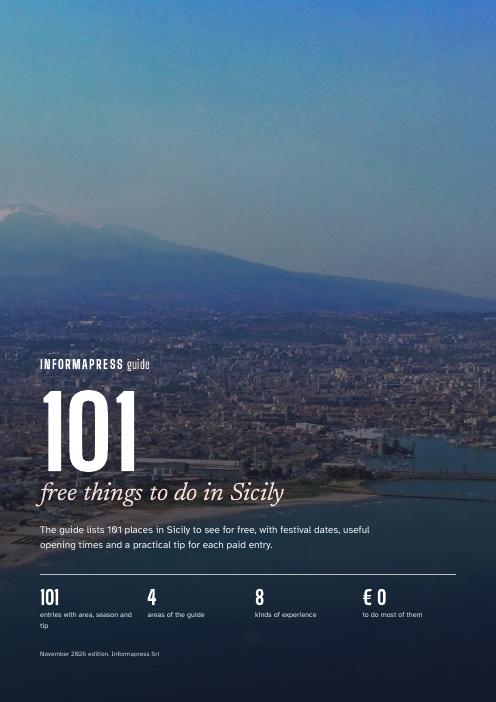
101 free things to do in Sicily
The guide lists 101 places in Sicily to see for free, with festival dates, useful opening times and a practical tip for each paid entry.
See the guide, €4.9050 pages, PDF in three languages
↓ The page continues below
Province by province
Agrigento
The province of Agrigento brings together the table of the Greek temples and the farm table of the hinterland. Between Ribera and Sciacca oranges grow, while the Belice valley and the hills of Canicattì give olives and table grapes. People eat pasta with sea sardines, couscous in the coastal towns, bread and wild greens, and excellent fish in Porto Empedocle and Sciacca. Among sweets worth remembering are almond torrone and almond biscuits, tied to the Almond Blossom Festival. The landscape sees olive and almond trees flowering between late winter and early spring.
- Arancia di Ribera Local productAn orange of the Washington Navel variety grown in Ribera and neighboring towns, in the area between Agrigento and Palermo. It is recognized by the small "navel" at its base, and the trees grow in vast irrigated citrus groves. It is harvested from November to April and is very sweet, with few seeds. The PDO status recognizes the quality of the area, irrigated by the Verdura river. It is eaten in segments and as juice, and it is a fruit closely tied to the farming identity of Ribera and the nearby villages.
- Nocellara del Belice Local productA table and oil olive grown in the Belice valley, with crisp flesh and a sweet flavor. It is harvested from September to November and is also eaten green, after being processed in brine or with the method called "alla siciliana". The olives are served as a starter, with bread and cheeses, or used in salads and sauces. From the same trees a fruity and delicate oil is also obtained. It is one of the best-known Sicilian table olives, and in Castelvetrano it is also a symbol of the territory.
- Uva da tavola di Canicattì Local productTable grapes, in particular the Italia variety, grown on pergolas in the Canicattì area. The bunches are large, golden and sweet, and are protected from insects and bad weather with light covers. The harvest runs from late summer to autumn, and the latest grapes are kept for the end-of-year festivities. It is eaten fresh, at the table, as fruit, or in fruit salads and desserts, above all in September and October.
- Vastedda della valle del Belice Local productA sheep's milk pasta filata cheese, shaped like a flattened focaccia, typical of the Belice valley. After the first processing, the curd is stretched by hand and shaped with the hands until a round, flat form is obtained. It is eaten fresh, within a few days, generally with a drizzle of oil and a little oregano. In the area it is a niche product, tied to the pastoral farms of the provinces of Trapani, Agrigento and Palermo. It is one of the few PDO pasta filata cheeses made from sheep's milk.
Caltanissetta
In the heart of the island, the province of Caltanissetta is a land of wheat, sulphur and olive trees. Bread is the protagonist of the table: made with remilled semolina, it smells of the wood-fired oven and is eaten on its own or dressed. Among the specialities are almond sweets and the country cooking of pulses, vegetables and sheep's cheeses. The hills near the plain of Gela produce grapes and red wines from Sicilian varieties, and the villages near Vittoria share with Ragusa the most famous wine of the area.
- Pagnotta del Dittaino Local productA durum wheat semolina bread from grains grown in the valley of the Dittaino river, with a golden crust and a yellow, compact crumb. It is made with sourdough starter and baked in a wood-fired oven, and the traditional shape is a large round loaf. It keeps for a long time and is used to accompany cheeses, cured meats and peasant soups. It is found in the bakeries of the Sicilian hinterland and at markets, and is also appreciated toasted with oil and salt.
- Uva da tavola di Canicattì Local productTable grapes, in particular the Italia variety, grown on pergolas in the Canicattì area. The bunches are large, golden and sweet, and are protected from insects and bad weather with light covers. The harvest runs from late summer to autumn, and the latest grapes are kept for the end-of-year festivities. It is eaten fresh, at the table, as fruit, or in fruit salads and desserts, above all in September and October.
- Cerasuolo di Vittoria WineIt has a light ruby red color and aromas of red fruit, with a soft, fresh flavor. The two grape varieties combine to give a balanced wine, which is drunk with white meats, cheeses, first courses with meat sauces and flavorful fish dishes. The production area revolves around Vittoria and the nearby towns, and it is one of the oldest for viticulture in Sicily.
Catania
Catania is the capital of volcanic cooking. From pasta alla Norma to arancine, from the pistachios of Bronte to the prickly pears of Etna, the territory is a mosaic of flavours. The historic Pescheria market offers fresh fish, meat and vegetables in a spectacle of voices and colours. Red oranges grow in the Piana, and the wines of Etna climb to over a thousand metres. People eat granita with brioche for breakfast, grilled horse meat and almond sweets with citrus. In Bronte pistachio goes into creams, pastas and gelato.
- Pasta alla Norma First courseMaccheroni with tomato, fried eggplant, ricotta salata and basil, a symbol of Catania cooking. The eggplants are cut into slices or cubes and fried before being added to the sauce, while the ricotta salata, aged and hard, is grated over the top like rain. According to tradition the name is a tribute to Bellini's opera, born in Catania, to say that the dish was a true "Norma" of the table. It is made above all in summer, when eggplants are sweeter and tomatoes riper.
- Arancine Street foodGolden fried balls of rice with a heart of ragù, peas and caciocavallo, or of ham and béchamel. The rice, cooked and cooled, is shaped by hand, filled, rolled in breadcrumbs and fried in plenty of oil. In Palermo and western Sicily they are usually called arancine and are round; in Catania they are arancini and cone-shaped, recalling Etna. They are eaten all year round, in fried-food shops and rosticcerie, and in particular on 13 December, the feast of Saint Lucy.
- Pistacchio verde di Bronte Local productA pistachio of an emerald green color grown on the lava soils of Etna, in the area of Bronte, Adrano and Biancavilla. The plants grow on steep, arid ground, often on terraces of dark rock, and are tended with almost artisanal care. The harvest takes place in alternate years, usually between August and September, and is done by hand. In cooking it is used in sweets, ice creams and sauces, in fillings and in dressed pasta, and is called "green gold". In Bronte, in autumn, a very well-attended festival is held.
- Ficodindia dell'Etna Local productThe fruit of the prickly pear grown on the slopes of Etna, in particular between San Cono and Biancavilla. There are three varieties, yellow, white and red, harvested above all in August and September. The pads of the plant, full of spines, are grown on lava soils and the fruit must be peeled with care. It is eaten fresh, well chilled, and used for jams, mostarda and sweets. Often a second, later harvest is also cut, called "bastardone", which arrives in autumn and is much appreciated.
- Limone dell'Etna Local productA citrus fruit grown on the slopes of Etna, with a strong flavor and a fragrant peel. The trees grow on volcanic soil, in bands rising from the sea toward the villages at the foot of the mountain. It is harvested several times during the year, and the different blooms give distinct harvests, a main one in winter and a smaller one in summer. In the kitchen it is used for granitas, desserts, dressings and marinades, and the untreated zest is grated over fish dishes or salads.
- Etna DOC WineWhite, red and rosé wine grown on the slopes of Etna, even at over a thousand meters of altitude. The red is made of Nerello Mascalese and Nerello Cappuccio, the white of Carricante. The volcanic soils and the strong temperature swings give mineral and fresh wines. The vines, often bush-trained and on terraces of lava stone, are harvested by hand in October, late compared with the rest of the island. The red goes with meats and cheeses, the white with fish and vegetables. It is one of the most appreciated wine areas of the Mediterranean.
- Arancia rossa di Sicilia Local productA group of varieties such as Tarocco, Moro and Sanguinello, with flesh colored by anthocyanins. The red color develops when cold nights alternate with sunny days, a common condition on the slopes of Etna. They are grown on the Catania plain and in nearby areas, from autumn to late spring. They are eaten in segments, as juice and in salads with fennel, olives and a drizzle of oil. They are also used for marmalades, sorbets and desserts, and a glass of blood orange juice is a typical breakfast of the Sicilian winter.
- Granita with brioche DessertLemon, almond, mulberry or coffee granita served with a brioche col tuppo, a typical Sicilian summer breakfast. It is made with water, sugar and fruit or other flavorings, stirred and chilled until small ice crystals form. The texture changes from area to area: creamier in Messina and Catania, more icy in the Ragusa area. The soft bread is dipped into the granita, and according to local custom it is a perfectly normal way to start the day. In the coffee version a cloud of whipped cream is often added.
Enna
Enna, the most inland and mountainous province, has a cuisine of shepherds and farmers. Cheese is king: saffron piacentinu and aged pecorino accompany dark bread, cured meats and country vegetables. The pagnotta del Dittaino, with its golden crust, is among the most famous breads of the island. In the villages people cook pulse soups, lamb and pork, and in festive periods cannoli and almond sweets. The areas near the southern slope of Etna also offer red oranges.
- Piacentinu ennese Local productA sheep's cheese flavored with saffron and black peppercorns, with an intense yellow color and a characteristic aroma. The milk is curdled warm with the addition of saffron, and the cheeses are left to mature for a few months in cool rooms. According to tradition, saffron served to "heal" the milk, and the name recalls the Sicilian word "piacentinu", meaning pleasing. It is made in the Enna area, usually from autumn to spring. It is eaten in slices with bread and olives, or grated over first courses and vegetables.
- Pagnotta del Dittaino Local productA durum wheat semolina bread from grains grown in the valley of the Dittaino river, with a golden crust and a yellow, compact crumb. It is made with sourdough starter and baked in a wood-fired oven, and the traditional shape is a large round loaf. It keeps for a long time and is used to accompany cheeses, cured meats and peasant soups. It is found in the bakeries of the Sicilian hinterland and at markets, and is also appreciated toasted with oil and salt.
- Arancia rossa di Sicilia Local productA group of varieties such as Tarocco, Moro and Sanguinello, with flesh colored by anthocyanins. The red color develops when cold nights alternate with sunny days, a common condition on the slopes of Etna. They are grown on the Catania plain and in nearby areas, from autumn to late spring. They are eaten in segments, as juice and in salads with fennel, olives and a drizzle of oil. They are also used for marmalades, sorbets and desserts, and a glass of blood orange juice is a typical breakfast of the Sicilian winter.
Messina
Messina offers two faces: the sea of the Strait and the mountains of the Nebrodi and Peloritani. From the sea comes swordfish, protagonist of the rolls and of the ghiotta. On the Aeolian Islands, in Salina, capers of a quality appreciated all over the world grow, along with the sweet malvasia. On the Nebrodi provola and black pig are produced, with a cuisine of woods and shepherds. In Messina coffee granita with cream and brioche is a ritual to enjoy at breakfast. Among sweets are fried pidoni and pignolata, covered in lemon and chocolate glaze.
- Involtini di pesce spada Main courseThin slices of swordfish rolled up with breadcrumbs, raisins, pine nuts, capers and parsley, cooked on the grill or in the oven. The filling is bound with a little oil and sometimes with cheese, and the rolls are threaded two at a time onto a skewer with bay leaves and slices of onion. They are a classic of the Strait of Messina, where swordfish fishing has been practiced for centuries, and the best period is usually from May to August. They are served with lemon and a side of salad or vegetables.
- Cappero delle isole Eolie Local productA caper grown on Salina and the other Aeolian Islands, in volcanic soils. The plants grow along the low walls and on the terraces, and the flowers are picked by hand, one by one, in a season that runs from spring to summer. Buds and cucunci, the fruits, are picked by hand and preserved in salt or in vinegar. The status is PGI, although in local accounts the abbreviation PDO is sometimes found. They are used in salads, with swordfish and in sauces, and are among the most characteristic products of Salina.
- Provola dei Nebrodi Local productA pasta filata cheese made from cow's milk from the Nebrodi mountains, pear- or sack-shaped, with a smooth, thin rind. The curd is stretched by hand in hot water and the wheels are tied in pairs, hung from a beam to age. It is eaten fresh or aged, also smoked, in slices, with bread and vegetables preserved in oil, or grilled on a hot plate. The PDO status covers an area of mountain pastures in the Messina area, where cows of the Modicana breed and other local breeds feed on wild herbs.
- Granita with brioche DessertLemon, almond, mulberry or coffee granita served with a brioche col tuppo, a typical Sicilian summer breakfast. It is made with water, sugar and fruit or other flavorings, stirred and chilled until small ice crystals form. The texture changes from area to area: creamier in Messina and Catania, more icy in the Ragusa area. The soft bread is dipped into the granita, and according to local custom it is a perfectly normal way to start the day. In the coffee version a cloud of whipped cream is often added.
Palermo
Palermo is the capital of Sicilian street food. In the historic markets of Ballarò, the Capo and the Vucciria people eat panelle, crocchè, pani ca meusa, sfincione, stigghiola and arancine (in Palermo arancine in the feminine, in Catania arancini in the masculine, a friendly dispute that divides the island). The Palermo sweet par excellence is the cassata, alongside cannoli, frutta martorana and cuccia. Pasta with sardines is the most representative first course, while caponata accompanies the table. The Madonie, in the interior, offer cheeses, mushrooms and meats.
- Panelle Street foodThin fritters of chickpea flour cooked with water and salt, fried in oil and eaten in a bread roll with potato croquettes. The mixture is cooked while stirring until it comes away from the pot, spread in thin layers and cut into rectangles before frying. They have been sold in Palermo and the surrounding area for centuries, and according to tradition they arrived with the Arabs. They are eaten at breakfast, as an afternoon snack or as a starter, with a squeeze of lemon. At the festival of Santa Rosalia, on July 15, they are a classic of the festino.
- Pani ca meusa Street foodA soft sandwich with veal spleen and lung fried in lard, eaten in Palermo in the historic markets such as Ballarò and the Capo. The bread is the vastedda, a round focaccia sprinkled with sesame seeds, which soaks up a little of the cooking fat. You can ask for it 'schietto', with only salt and lemon, or 'maritato', with ricotta or caciocavallo. It is one of the oldest street foods of the city, and according to tradition it spread among butchers of Jewish origin. It is eaten hot, standing, in front of the stall.
- Sfincione Street foodA soft, thick pizza with onion, tomato, anchovies, caciocavallo and toasted breadcrumbs, also sold in Palermo by street vendors. The dough, leavened for a long time, is baked in a pan and topped with a thick sauce of stewed onions. The most typical form is that of Bagheria, with less tomato and a drier dough. It is usually eaten around Christmas, but bakers make it all year round, and it is often bought by the slice, still warm, to take home in paper. It pairs readily with a glass of red wine.
- Stigghiola Street foodLamb or kid intestines wrapped around an onion or a leek, flavored with parsley and cooked over embers. After a long washing the innards are tied into a braid and grilled over a high flame, until they become golden and crisp. They are sold on the street in Palermo, amid smoke and aromas, above all on festive evenings and at festivals. The name probably suggests the idea of a small "flame" that lights up on the embers. They are usually eaten hot, with a squeeze of lemon, in a paper cone or on a paper plate.
- Arancine Street foodGolden fried balls of rice with a heart of ragù, peas and caciocavallo, or of ham and béchamel. The rice, cooked and cooled, is shaped by hand, filled, rolled in breadcrumbs and fried in plenty of oil. In Palermo and western Sicily they are usually called arancine and are round; in Catania they are arancini and cone-shaped, recalling Etna. They are eaten all year round, in fried-food shops and rosticcerie, and in particular on 13 December, the feast of Saint Lucy.
- Cannolo siciliano DessertA crisp shell of fried pastry rolled up and filled at the last moment with sheep's milk ricotta cream, chocolate chips and candied orange peel. The dough, flavored with a little wine or coffee, is rolled out thin, wrapped around cane or metal tubes and fried. It probably began as a Carnival sweet, but it is eaten in every season, in the pastry shops all over the island. The filling should be added last, so that the shell stays crumbly. It can be garnished with chopped pistachios or candied cherries.
- Cassata siciliana DessertA Palermo dessert of soaked sponge cake, sweetened sheep's ricotta with chocolate chips, green marzipan and candied fruit. The marzipan, made of almonds and sugar and coloured pale green, covers the cake and is decorated with candied fruit and sugar designs. According to tradition it is linked to Easter, but today it is found all year round in pastry shops. The baked version, simpler, is typical of some areas of the island. It is a rich and very showy dessert, to be served in thin slices.
- Frutta martorana DessertAlmond paste sweets shaped and painted to look like fruits and vegetables, originally made by the nuns of the Martorana convent in Palermo. The almond paste, made of almonds and sugar, is pressed into molds and colored by hand with food coloring. Traditionally they are given to children for the Day of the Dead, on November 2, as a gift from the departed. They are very realistic, so much so that they are sometimes mistaken for real fruit: lemons, prickly pears, pears and apples are among the most loved subjects. They are found in Sicilian pastry shops, especially in autumn.
- Cuccìa DessertBoiled wheat dressed with sweet ricotta, chocolate or milk cream, eaten on December 13, the day of Santa Lucia, when in Palermo and western Sicily people avoid eating bread and pasta. The wheat berries are left to soak for days and then boiled for a long time, until they become tender. According to tradition it recalls a miracle that ended a famine, with the arrival of a ship loaded with wheat. It is a simple and very symbolic preparation, which in some families is also served as a savory soup with chickpeas or beans.
- Pasta con le sarde First courseA Palermo dish of bucatini with fresh sardines, wild fennel, pine nuts, raisins and anchovy, finished with toasted breadcrumbs. The fennel is boiled and its water is then used to cook the pasta, which takes on a scent of anise. It combines the Arab heritage, which brings raisins and pine nuts, with the flavors of the sea and the countryside. Wild fennel is picked in spring, and that is when the dish is most gladly made. Some families also serve it for the feast of San Giuseppe.
- Caponata Side dishA sweet and sour dish of fried eggplant pieces with celery, olives, capers, onion and tomato, dressed with vinegar and sugar. Each vegetable is cooked with care, often separately, and then combined in the sweet and sour sauce, which gives the preparation its character. There are many local variants: in Palermo it is sometimes found with octopus or with almonds. It is usually served cold, as a starter or side dish, or on a slice of bread, and it is one of those recipes that improve after a day of rest. It is very common in the summer months.
Ragusa
The Ragusa area is a land of dry-stone walls, masserie and baroque. The most famous cheese is Ragusano, aged for a long time, while in Modica chocolate is worked cold according to an ancient method. The areas of Vittoria and Pachino give tomatoes and red wines, including Cerasuolo, with its fruity character. At the table people eat scacce, pastry sheets filled with vegetables, ricotta and sausage, pasta with pork ragù and almond sweets. Almond and mulberry granitas are appreciated in summer.
- Ragusano Local productA pasta filata cow's milk cheese, shaped like a parallelepiped, tied with ropes that make it look like a large brick. The raw milk is worked by hand in a wooden vat and the wheels are hung to age in pairs, in cool rooms, for a few months. It is produced in the Iblei, on the Ragusa plateau, from cows of the Modicana breed. When young it is eaten at the table, when aged it is grated. In cooking it goes with bread, olives and honey, and enters many home dishes, from baked pasta to rolls.
- Cioccolato di Modica Local productChocolate worked cold, with sugar that is not completely dissolved, which gives it a grainy texture. The cocoa paste is worked on a stone, the metate, at a low temperature, without the long refining typical of industrial bars. According to tradition it comes from Aztec methods brought by the Spaniards. It is found plain or flavored with cinnamon, vanilla, chili pepper or orange peel, in dark-colored bars. In Modica it is sold by old shops in the center, and in autumn a festival dedicated to chocolate is held.
- Cerasuolo di Vittoria WineIt has a light ruby red color and aromas of red fruit, with a soft, fresh flavor. The two grape varieties combine to give a balanced wine, which is drunk with white meats, cheeses, first courses with meat sauces and flavorful fish dishes. The production area revolves around Vittoria and the nearby towns, and it is one of the oldest for viticulture in Sicily.
- Pomodoro di Pachino Local productA tomato grown in the municipalities of Pachino, Portopalo and part of Noto and Ispica, generally in greenhouses on the coast. The mild climate and the soil close to the sea give the fruit a sweet flavour with a savoury touch. There are four types: cherry, ribbed, round smooth and cluster. It is harvested over long periods of the year, because the greenhouses allow several cycles, and is used fresh in salads, on bruschetta and for light sauces, often together with basil and oil.
- Granita with brioche DessertLemon, almond, mulberry or coffee granita served with a brioche col tuppo, a typical Sicilian summer breakfast. It is made with water, sugar and fruit or other flavorings, stirred and chilled until small ice crystals form. The texture changes from area to area: creamier in Messina and Catania, more icy in the Ragusa area. The soft bread is dipped into the granita, and according to local custom it is a perfectly normal way to start the day. In the coffee version a cloud of whipped cream is often added.
Syracuse
Siracusa and its province combine sea, citrus and almonds. The limone di Siracusa perfumes salads and sorbets, the almond of Avola goes into sweets and almond milk, and the tomato of Pachino, sweet and fleshy, is the base of many sauces. On the island of Ortigia, the market offers fish, sea urchins and vegetables. In Noto the famous almond granita is made, and in the Hyblaean villages people eat cheeses and meats. The red oranges of Francofonte and Lentini are among the best on the island.
- Limone di Siracusa Local productA citrus fruit grown in the coastal area of Syracuse, with a thin peel and abundant juice. Among its varieties is the femminello, which flowers several times a year, and the fruits are picked by hand at several times, with the peak between autumn and spring. It is used for granitas, sweets and dressings, and also gives fragrance to fish dishes, salads and roast meats. The untreated zest is used for liqueurs and candied peel. The lemon is a symbol fruit of this part of Sicily's eastern coast.
- Mandorla di Avola Local productAlmonds of the pizzuta, fascionello and romana varieties, grown around Avola. The pizzuta, in particular, is considered among the most prized for desserts and sugared almonds, thanks to its elongated shape and intense flavour. The harvest is done between August and September, when the hull opens and the fruits are left to dry. It is the base of Sicilian almond paste, of martorana fruit and of many biscuits. In the villages of the Syracuse area almond milk is also made, drunk cold in summer.
- Pomodoro di Pachino Local productA tomato grown in the municipalities of Pachino, Portopalo and part of Noto and Ispica, generally in greenhouses on the coast. The mild climate and the soil close to the sea give the fruit a sweet flavour with a savoury touch. There are four types: cherry, ribbed, round smooth and cluster. It is harvested over long periods of the year, because the greenhouses allow several cycles, and is used fresh in salads, on bruschetta and for light sauces, often together with basil and oil.
- Arancia rossa di Sicilia Local productA group of varieties such as Tarocco, Moro and Sanguinello, with flesh colored by anthocyanins. The red color develops when cold nights alternate with sunny days, a common condition on the slopes of Etna. They are grown on the Catania plain and in nearby areas, from autumn to late spring. They are eaten in segments, as juice and in salads with fennel, olives and a drizzle of oil. They are also used for marmalades, sorbets and desserts, and a glass of blood orange juice is a typical breakfast of the Sicilian winter.
- Ragusano Local productA pasta filata cow's milk cheese, shaped like a parallelepiped, tied with ropes that make it look like a large brick. The raw milk is worked by hand in a wooden vat and the wheels are hung to age in pairs, in cool rooms, for a few months. It is produced in the Iblei, on the Ragusa plateau, from cows of the Modicana breed. When young it is eaten at the table, when aged it is grated. In cooking it goes with bread, olives and honey, and enters many home dishes, from baked pasta to rolls.
Trapani
Trapani is the province of fish couscous, salt pans and tuna. Cuscus is the signature dish, while busiate with pesto trapanese are the first course best loved by families. The sale marino of Trapani, from the salt pans between Trapani and Marsala, and Marsala tell of a unique landscape of windmills and mirrors of water. In Pantelleria capers and passito flourish, in Favignana the tuna-trap tradition, in Erice almond sweets and almond paste in the shape of fruit. Nocellara del Belice olives are among the most appreciated.
- Cuscus alla trapanese First courseDurum wheat semolina worked by hand and steamed, served with a broth of rockfish flavored with garlic, onion and bay leaf. The semolina is rubbed into grains with the hands and oil in a large terracotta dish, the mafaradda, and then swells in the steam of the broth. It is a legacy of Arab culture, still alive in Trapani and San Vito Lo Capo. In San Vito an international event dedicated to couscous is held at the end of September, bringing together cooks from many Mediterranean countries.
- Busiate al pesto trapanese First courseA fresh pasta rolled in a spiral, busiate, dressed with a raw pesto of tomato, basil, almonds, garlic and pecorino. The ingredients are pounded in the mortar or blended without cooking, so the sauce stays fresh and fragrant. The name of the pasta comes from the iron rod, the "busa", around which it is wound. The dressing is tied to the port of Trapani, where the ships of the Genoese arrived, and is a sort of Sicilian cousin of Ligurian pesto. It is made above all with summer tomatoes, ripe and sweet.
- Sale marino di Trapani Local productSalt obtained from the salt pans along the coast between Trapani and Marsala, where the windmills are one of the symbol landscapes. The seawater passes from basin to basin, evaporates in the sun and leaves large, pale crystals, which are gathered by hand or with small equipment. The harvest takes place in summer, after months of sun. It is rich in minerals, and is also used to preserve fish, olives and capers. In the area you can visit the salt pans and the salt museum, with the basins that turn pink at sunset.
- Marsala WineA fortified wine from the Marsala area, made famous in the eighteenth century by the Englishman John Woodhouse. It is made from local grapes such as grillo, and has a long maturation in wooden casks, in cellars often a few steps from the sea. It comes in gold, amber and ruby versions, dry or sweet, and with different ages. In cooking it is used for scaloppine, in zabaglione and in sweets, and as a dessert wine it is served at the end of a meal, with dry pastries or aged cheeses. The "vergine" versions are among the longest aged.
- Cappero di Pantelleria Local productFlower buds of the caper grown on Pantelleria, picked by hand from May to August and preserved in salt. The plant grows in dry-stone walls and stony ground, with very little water, and the harvest is repeated every few days. After salting, the capers are rinsed and used in the kitchen. They have an aromatic, only slightly bitter flavor. They are used in salads, in caponata and in many recipes of the island, for example with tuna, in pasta dressed with fresh tomato and in the pantesca salad.
- Passito di Pantelleria WineA sweet wine from zibibbo grapes (Muscat of Alexandria) dried in the sun, grown as bush vines on the volcanic stone terraces of Pantelleria. The technique of the Pantelleria bush vine was recognized by UNESCO in 2014. After the harvest, the bunches are spread out to dry on racks, then worked with care, in a production of small quantities. Golden or amber in color, with aromas of apricot and honey, it is drunk at the end of a meal with dry sweets, blue cheeses and Sicilian pastries.
- Nocellara del Belice Local productA table and oil olive grown in the Belice valley, with crisp flesh and a sweet flavor. It is harvested from September to November and is also eaten green, after being processed in brine or with the method called "alla siciliana". The olives are served as a starter, with bread and cheeses, or used in salads and sauces. From the same trees a fruity and delicate oil is also obtained. It is one of the best-known Sicilian table olives, and in Castelvetrano it is also a symbol of the territory.
- Vastedda della valle del Belice Local productA sheep's milk pasta filata cheese, shaped like a flattened focaccia, typical of the Belice valley. After the first processing, the curd is stretched by hand and shaped with the hands until a round, flat form is obtained. It is eaten fresh, within a few days, generally with a drizzle of oil and a little oregano. In the area it is a niche product, tied to the pastoral farms of the provinces of Trapani, Agrigento and Palermo. It is one of the few PDO pasta filata cheeses made from sheep's milk.
Street food and markets
- JanuaryJanuary is the month of citrus and red oranges, which reach their most colourful flesh, and of broccoli, cauliflower and artichokes. People cook pulse soups and vegetable minestre, while pork stays on the fire. In the days of the Epiphany Christmas sweets are still remembered.
- FebruaryFebruary is the month of Carnival: cannoli, chiacchiere and fried sweets everywhere. According to the traditional calendar of Agrigento the Almond Blossom Festival is held between February and March, with almond trees blooming over the Valley of the Temples. On Sant'Agata, 5 February in Catania, people eat the minne di Sant'Agata, breast-shaped sweets with ricotta and chocolate.
- MarchIn March spring brings broad beans, peas, artichokes and wild asparagus, with which frittedda is made. For the feast of San Giuseppe, on 19 March, in many villages votive tables are laid out full of bread, vegetables and sweets, and sfinci di San Giuseppe are eaten.
- AprilApril is the time of Easter, with roast lamb, cassata, sugar pupi and lamb of almond paste. People eat the last oranges, the first strawberries and ricotta ravioli. Many families eat their Easter meals outdoors.
- MayMay brings the first cherries, loquats, apricots and courgette flowers. It is the month of outings and of scacce. Oily fish is excellent, with sardines and anchovies in season. In the countryside capers are gathered.
- JuneIn June the table is made of tomatoes, aubergines, peppers and basil. Cold pasta is prepared and granitas begin to be everywhere. In the Aeolian Islands capers are gathered, while the feasts of the patron saints begin with stalls of sweets.
- JulyJuly is dominated by granitas, mulberries, prickly pears on the way, peaches and melons. In Palermo, for the feast of Santa Rosalia, tradition calls for snails and babbaluci, cooked with garlic and parsley. Swordfish is in full season on the Strait.
- AugustAugust is the month of prickly pears, preserving tomatoes and grilled fish on the beaches. Tomato preserves, sauces and capers are prepared. For Ferragosto big communal tables are organised. In the villages neighbourhood festivals multiply.
- SeptemberIn September grapes are harvested and the sweetest prickly pears are picked. In San Vito Lo Capo a festival dedicated to couscous takes place, and in several villages festivals of pistachio, wine and almonds are not missing. At the end of the month the Sagra del Pistacchio di Bronte usually begins.
- OctoberOctober brings the Sagra del Pistacchio di Bronte, which usually extends between the end of September and the first days of the month, and the Ottobrata of Zafferana Etnea, dedicated to the products of Etna. Olives and grapes are gathered, and the first musts are drunk. In Menfi wine is celebrated with a traditional festival.
- NovemberNovember is dedicated to the dead: on 2 November frutta martorana and the sweets of the dead are made, including sugar pupi and ossa dei morti. Olives are gathered and the new oil is pressed, to be tasted on a slice of bread. People cook soups and chestnuts, and cauliflower is in season.
- DecemberDecember begins with the 13th, the feast of Santa Lucia, when people eat cuccia and avoid bread. At Christmas buccellati stuffed with dried figs and dried fruit appear, along with cassata, cannoli, torrone and capitone in the seaside towns. Orange salad with fennel and olives is prepared.
How people eat today: osterie, village festivals and habits
In Sicily people eat unhurriedly and abundantly. Lunch is the main meal, especially on Sunday, and often lasts hours, with starters, first course, main course and dessert. The summer breakfast is a ritual, with granita and brioche, while in winter people prefer a cornetto with cream or ricotta. Coffee is taken at the counter, and in Sicilian bars gelato in a brioche is a common snack.
Family trattorias and osterie still offer the dishes of tradition, often with a menu recited aloud or with dishes that change with the season. The sagre, the village food festivals, in summer and autumn, are the gateway to local products. The farm stays of the hinterland let you taste cheeses, bread, oil and meats directly from the producers. Good advice is to eat where the locals eat, accept recommendations on the fish of the day and leave room for dessert.
The table through the year
Did you know
- According to tradition, the name of pasta alla Norma is a tribute to Bellini's opera, born in Catania, and is meant to indicate a dish as 'perfect' as the opera.
- In Palermo people say 'la arancina' in the feminine, in Catania 'l'arancino' in the masculine: a dispute that divides the inhabitants of the island.
- The pistachio of Bronte is usually harvested every two years, because the plant alternates years of full production with years of rest.
- Modica chocolate, according to tradition, recalls a method brought by the Spaniards, in which the sugar is not fully dissolved, leaving the typical grain.
- Cuccia is eaten on 13 December in honour of Santa Lucia, and according to legend it recalls a shipment of wheat that arrived during a famine.
- The bush-trained vine of Pantelleria has been recognised by UNESCO as an intangible cultural heritage of humanity.
- Trapani couscous is steamed over a fish broth, and in San Vito Lo Capo a festival is dedicated to it every year with cooks from many Mediterranean countries.
- The word 'sorbet' has Arabic origins, and according to tradition the snow of Etna was brought down to cool drinks already in ancient times.
- Frutta martorana, according to tradition, was born in the Martorana convent in Palermo, where the nuns are said to have decorated the trees with fruit made of almond paste.
- Marsala became famous in the eighteenth century thanks to English merchants who appreciated it and exported it as an alternative to Iberian fortified wines.
- The red orange of Sicily owes its colour to anthocyanins, pigments that develop with the strong temperature swings between day and night on the slopes of Etna.
- In the bread of many areas of the island remilled durum wheat semolina is used, while the sesame on the crust is called 'giuggiulena' in dialect.
Practical tips
- For a summer breakfast order granita with brioche, preferably early in the morning and in a café frequented by locals.
- In Palermo try the street food in the markets of Ballarò and the Capo: panelle, crocchè and sfincione are usually eaten just fried.
- Always ask for the fish of the day and have them tell you which is in season: swordfish, sardines and red prawns have precise periods.
- Pani ca meusa is ordered schietto, with a little lemon, or maritato, with ricotta and caciocavallo: the difference is in the taste.
- Buy typical products (pistachios, capers, salt, almonds) in producers' shops and markets, checking the origin on the label.
- Avoid looking for cannoli already filled in the shop windows: the best are filled at the last moment, to keep the shell crisp.
- Choose the time of your trip according to the products: almond blossom in February, pistachios in autumn, red oranges from January to April.
- For wine, try Etna wines at different altitudes, Cerasuolo di Vittoria with cheeses, dry Marsala with cheese and the passito of Pantelleria with sweets.
- Do not look for pasta with cheese on fish: in Sicilian usage toasted breadcrumbs are used, and asking for Parmesan may seem strange.
- Lunch can start late and last a long time: if you want a table in the most popular places, book in advance, especially on Sunday.
Editorial texts by Italy Travel Escape. Designations checked on the EU eAmbrosia register.
Tours and activities nearby
Offers from GetYourGuide. Some links are affiliate links: if you book we may earn a commission at no extra cost to you.